What Are Network Operations Center (NOC) Services?

Learn how NOC services enables you to meet demanding infrastructure support requirements and gain full control of your infrastructure’s technology, support, and operations in 2026.

1 Introduction

imageonline-co-roundcorner (1)

What are NOC Services?

NOC (network operations center) services are a set of support processes, technologies, and organizational solutions that enable a client’s business processes.

For organizations that cannot justify the expense of setting up and operating an internal 24x7 NOC, outsourcing these services to a qualified service provider can be a practical and cost-effective option. NOC service providers offer inherent economies of scale, making outsourcing IT system support cost-effective.

The best NOC service providers not only handle monitoring and management but also have the people, processes, and platform to deliver a high-quality service that simply wouldn’t be possible to achieve in-house.

To give you a sense of the sophistication you can find in a modern NOC support partner, here's our own VP of Technology, Jim Martin, explaining the mechanics of our support platform—Ops 3.0:


INOC Ops 3.0

ino-Platform3.0-01


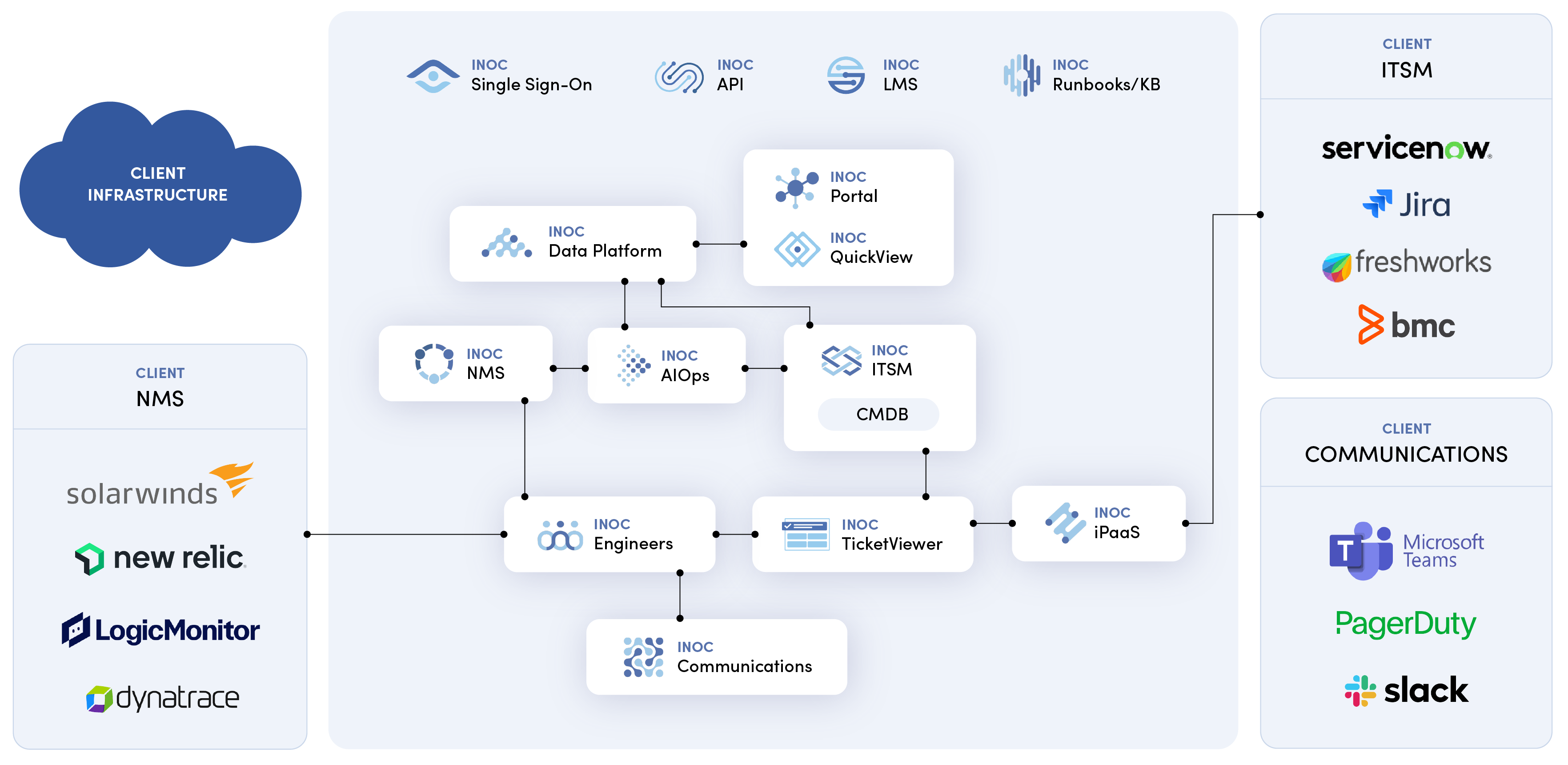
The platform of tools and systems for delivering service is a crucial factor in the success of any high-performance NOC. It’s what enables the NOC’s speed, accuracy, and consistency. At INOC, we’ve significantly invested in developing and refining our platform to deliver comprehensive NOC services to clients and partners 24x7x365.

Our latest and third major iteration of the platform is INOC Ops 3.0.

This platform serves as our operating system—the intersection of technology, operations, and service delivery. Its design enables us to ingest alarm feeds from various sources, auto-correlate those events into a single ticket, and present that ticket through a single pane of glass for efficient Incident, Problem, and Capacity Management.

In short, the Ops 3.0 platform enables our team to increase its accuracy and speed while reducing delays in human involvement. It frees NOC engineers to spend less time in the runbook and more time on strategic client projects.

INOC Layers

Backing up: what is a NOC?

A NOC is the central location from which an organization supports its network and/or telecommunications infrastructure—servers, applications, cloud, routers, switches, circuits, UPS, environmental sensors, security cameras, and other devices. It’s a critical component of any IT support function, providing real-time monitoring and rapid response to issues that arise within the network.

The NOC monitors, detects, and resolves infrastructure events as they happen by interacting with monitoring and management systems, technical specialists, and external equipment/carrier vendors. A NOC is not a Help Desk, which, in most cases, is primarily set up to handle end-user issues and provide PC/laptop, application, and basic network connectivity support.

Organizations can choose to build their own NOC on-premise, or, as is increasingly popular today, can opt to outsource part or all of the function to a specialist NOC service provider—ideally one that offers a cost-effective alternative to an in-house NOC by eliminating the need to hire, train, and retain in-house staff.

Again, some NOC service providers can leverage economies of scale to provide higher-quality services at a lower cost thanks to investments they’re able to make that simply wouldn’t be feasible for most in-house ITOps, Network Operations, or similar types of teams. Regardless of the setup, NOCs play a crucial role in detecting issues and making fast restoration and resolution decisions.

The main point

No matter what kind of business you run, your IT infrastructure and applications are bound to be affected by outages. Every second of downtime can cost you time and money.

A properly built, well-managed NOC not only mitigates these losses but also improves network, infrastructure, and application performance. By contrast, a poorly designed and managed NOC leaves your technology investments—and the business activities that rely on them—exposed and vulnerable.

The control and assurance once afforded by keeping the NOC in-house have largely been upstaged by third-party service providers that have bridged those gaps and developed platform capabilities that simply wouldn’t be viable in-house investments due to low utilization.

With the same or better level of control and the significant cost-efficiencies gained by eliminating the need to build and maintain a platform and staff in-house, it’s vital for any company seriously considering an in-house NOC to carefully determine whether the added costs, effort, and responsibilities are worth it.

Having provided a comprehensive catalog of NOC Lifecycle Solutions®, including NOC support, optimization, design, and build services for enterprises, communications service providers, and OEMs for 20+ years, we’ve written this guide to introduce basic and advanced NOC service concepts in a single, authoritative resource.

If you find this guide helpful, be sure to check out some of our other popular guides on various NOC topics:

NOC Runbooks | NOC Dashboards | NOC Operations | Staffing a NOC | NOC Automation | NOC Best Practices | NOC Management | NOC as a Service | NOC Metrics | NOC Tools and Software | Building a NOC | NOC SLAs


Have questions about outsourced NOC support or want to discuss a possible engagement? Learn more about our services and contact us to help you find your optimal NOC solution.

2 What Are NOC Services?


imageonline-co-roundcorner


Why do companies outsource their NOC operation?

Simply put, NOC service providers a more reliable and cost-effective way to monitor and manage networks and infrastructure.

By strategically outsourcing these services to a third-party provider, organizations can benefit from improved network and infrastructure performance and availability, cost savings, enhanced security and reliability, improved efficiency and productivity, and access to skilled and specialized staff.

Outsourced NOC services can be particularly beneficial for organizations that don't have the resources or expertise to manage these tasks in-house or that want to focus on their core business operations rather than managing their IT infrastructure.

But a high-performing NOC service provider does more than just keep your network, infrastructure, and applications up and running. It can quickly inform impacted users of a problem, enabling them to shift their attention to other tasks without skipping a beat.

The faster users realize a billing application is down, for example, the faster they can shift to email or other tasks. Across the organization, these downstream actions add up to immense savings in time and attention that would otherwise be lost to miscommunication and confusion.

Based on a collection of survey data, Gartner reported the average cost downtime at $5,600/minute or well over $300K/hour.


This productivity advantage is the number one reason companies approach their NOC service as a business investment rather than a cost center. Simply put, the value your NOC can return to the business is far greater than the investment necessary to make it effective.

In addition to detecting issues, the right NOC service will oversee corrective actions to restore service functionality after an outage. Here, the service provider offers a golden opportunity to keep the business moving during downtime by improving communication between key stakeholders—both those whose work is impacted and those fixing the problem.

Unlocking this capability requires a centralized operational framework to deliver information and take action at lightning speed—shortening response and restoration times while giving staff the information they need to adjust to the outage quickly. 

INOC Space Break (1)

The tiers of NOC services

Not all NOC support providers deliver the same services, but depending on the company, NOC service providers typically provide support across each traditional Tier or level, 1, 2, and 3.

Notification support

Detecting and identifying events from alarms, calls, and emails related to network and security equipment, circuits, cloud infrastructure, and applications. This also includes creating incidents and notifying or escalating them to the client or customer until the incident has been acknowledged.

Tier 1 support

At Tier 1, support includes initial event correlation, determination of infrastructure and service impacts, and incident prioritization within established SLA timeframes, in addition to the scope of Notification Support. Here at INOC, for example, we work most issues to resolution without impacting client teams at all. This is a central advantage to outsourcing NOC support to a highly capable service provider. Our Tier 1 resolution rates typically sit between 60% and 80% of all issues. More on that later.

Advanced (tier 2 & 3) support

Advanced support teams expand on Tier 1’s expertise to include a deeper, investigative level of troubleshooting expertise in network and IT technologies, along with specialized knowledge for highly involved resolution.


H
ow does pricing work?

There are two primary pricing models for outsourced NOC services: fixed per-device pricing and activity-based operational pricing.

  • Fixed per-device pricing is exactly what it sounds like. Devices are either categorized and priced by type, or, more generally, as a total number of “devices” or “nodes.”
  • Adaptive operational activity pricing is a more sophisticated model that sets prices based on actual NOC activity levels measured across your supported infrastructure over time.

While the number of devices requiring monitoring and support is always a critical factor when pricing NOC service, in our view, it’s often an overly simplistic long-term pricing factor to be used on its own, except in specific circumstances.

Especially for companies outsourcing to avoid an expensive, underutilized in-house NOC, adopting flat, all-inclusive service pricing that tracks activity levels can significantly lower overall service costs while retaining the ability to project costs as you would with fully fixed per-device pricing.

Here at INOC, our NOC services are custom-priced based on a few key factors—the first being the volume of incidents handled or projected to be handled each month. The second pricing factor is the size and composition of the infrastructure or number of devices within the supported environment. Pricing is also affected by the nature of the integration work required to enable our support. Get in touch with us to learn more.

📄 Read our other guideOutsourced NOC Pricing: A Buyer’s Guide—for a much deeper dive into the way NOC services are typically priced, and which model best suits your needs. Want to learn more about our specific approach to pricing NOC service? Download our pricing explainer (PDF).


What are the various NOC support models available?

Support models may look different from one service provider to another. Here at INOC, our NOC support clients receive service through one of four models, depending on their needs or desired service arrangement:

  • The Shared NOC Support model utilizes our team of over 100 staff to provide NOC support for hundreds of clients. This model offers clients a cost-effective alternative to hiring dedicated resources when low utilization and other factors can’t justify the cost of an in-house or dedicated team. Because the same team supports multiple clients, clients using this model must connect to our support platform.
  • In the Hybrid NOC Support model, our shared NOC team handles Tier 1 support activities, but we escalate to specific Tier 2 and 3 specialists that are partially or fully assigned to a specific partner or client for a given period of time—whenever those resources are needed. These advanced staff can use client-specific tools if needed or desired.
  • In the Dedicated NOC Support model, a team of NOC engineers “lives in” one partner’s or client’s tools all the time—solely supporting their environment within their environment. This model is most similar to a traditional IT staff augmentation model where staff are managed by our team but work exclusively with another organization’s tools and processes.
  • In the Designated NOC Support model, perhaps two or three partners or clients are supported by a single, dedicated team. This model is ideal for organizations that require or prefer dedicated resources but don’t have the activity volume to justify having a fully dedicated team all to themselves. This team can operate with the client’s tools, INOC’s tools, or a combination.

3 The Types of NOC Services

A NOC services provider will typically offer a catalog of services that fit into or across the tiers identified above.

Here’s a look inside our service catalog to give you an idea of what specific services roll up under “NOC services”:

Event Monitoring and Management involves monitoring, detecting, and processing events and faults related to client networks, IT infrastructures, and services, such as status changes or usage, to determine the appropriate action, often resulting in an incident being logged for fault management.

Incident Management involves detecting and resolving incidents to restore services as quickly as possible and minimize downtime of clients’ proactively monitored infrastructure and services.

Problem Management involves finding the root cause of a problem, providing a solution, preventing recurrence—and in a highly optimized NOC—preventing problems from occurring in the first place. Here at INOC, our Standard Problem Management includes performing activities needed to diagnose the root cause of incidents and submitting change requests to resolve those problems. Predictive Problem Management aims to avoid incidents proactively. This service also maintains information about problems and workarounds for use by Incident Management.

Capacity Management involves recording and managing the performance, utilization, and capacity of clients’ infrastructure components to ensure client service-level targets are being met.

Product Support, while a less common NOC service, provides white-labeled technical support to clients of system integrators, OEMs, and independent software vendors.

Help desk support typically involves recording and managing service requests—for information, advice, standard troubleshooting support, or access to a service—for clients' end users and end customers.

Here at INOC, we offer Service Transition Planning and Support—working together with our clients to define the specific steps for the initial setup of support, including per-customer onboarding, if applicable.

We also provide New Service Onboarding services to help onboard our clients' new customers with client-supplied information and assistance. This covers all the services included in standard turn-up support, including CMDB setup, connectivity, ticket system, alarm monitoring setup, call and email setup, NOC runbooks, and much more.

Change Management involves recording and managing changes to infrastructure, services, and monitoring. After New Service Onboarding is complete, we make subsequent changes to our support to reflect changes in clients’ or their customers’ infrastructure and support environments. These changes include scheduled maintenance support as well as Requests for Change, including move, add, change, and delete requests.

Service Asset and Configuration Management, or SACM defines the service and infrastructure components required to deliver services to our clients and maintains accurate configuration records. Configuration records also include service and asset relationship information. This support process allows for better Change Management, Incident Management, and Problem Management and ensures adherence to standards, legal requirements, and regulatory obligations


A Few Key Considerations

  • How quickly would you detect and respond to a critical service issue outside normal business hours?

  • How often do the same incidents recur because root causes are not fully identified and resolved?

  • Do you have a complete and accurate view of your infrastructure and service dependencies when an issue occurs?

  • Are changes to your environment consistently assessed, documented, and supported without increasing risk or downtime?

  • Can your current operations scale as your infrastructure and customer base grow—without degrading service levels?

See some room for improvement? Get in touch and let's discuss possible solutions.

4The Advantages of NOC Services

Although some may assume an in-house NOC affords greater control and is therefore preferred, the right outsourced NOC operation can offer a suite of capabilities and efficiency advantages that dramatically tip the scale in terms of cost, scalability, and practical considerations like employee morale.

This is especially true for enterprises and communications service providers looking to support themselves or their customers—and managed service providers (MSPs) looking to partner with a NOC service provider to add or enhance their managed service offering.

With the same or better level of control and the significant cost-efficiencies gained by eliminating the need to build and maintain what would otherwise be an under-utilized internal NOC platform and team, it’s vital for any company seriously considering an in-house NOC to carefully determine whether the added costs, effort, and responsibilities are worth it before standing up a NOC themselves.

Below, we’ve broken down a few of the significant factors that have led most of our clients to outsource their NOC to us.

1. Instant operational maturity and access to expertise

Compared to the months or years it can take to find NOC specialists, build a team, and bring an operationally mature NOC to life in-house, turning up support with an outsourced NOC condenses that time and effort into just a few weeks—often at a much lower cost.

Finding NOC specialists with the requisite domain expertise is a challenge in itself. Developing an operational framework for the NOC is an underappreciated project that requires exceptionally specialized experience, which can be difficult to find in the labor market.

This talent specialization is critical to ensuring the NOC can effectively navigate all the operational challenges that impede its success and flexibility.

Operational blindspots—the things you don’t know you don’t know—are a frustratingly common tripping point that can have far-reaching consequences for a NOC and the business. When the NOC isn’t thoughtfully operationalized around specific challenges, it has almost certainly signed itself up for stressful and expensive problem-solving down the road (not to mention unhappy end-users and customers).

2. Lower total cost of ownership

Companies often find that the monthly cost of outsourcing is far less than maintaining an in-house team. A fully staffed NOC can be a major expense, but outsourcing can provide comparable or better support at a lower cost through economies of scale.

When considering the costs of downtime, salaries, overhead, training, turnover, licensing, consulting, and other expenses, outsourcing can often halve the total cost of ownership. These savings extend beyond obvious costs, with many potential expenses overlooked in the initial planning stages.

Consider the following cost questions:
  • Have you compared the costs of hiring an in-house team to an outsourced team?
  • How do the requirements necessary for maintaining an effective NOC impact the payroll expenses for securing expertise?
  • Have you considered the back-office staff needed to support the NOC and its associated costs?
  • Have you considered the full-freight costs of purchasing and implementing an AIOps platform? Do you have the operational capability and expertise to continually improve its machine learning to make better correlations and reduce MTTR in responding to incidents?
  • Is your human resources team aware of and prepared for the added workload of hiring into an in-house NOC?


3. Faster speed to market

The third significant difference between in-house and outsourced NOCs is the time it takes to bring service online. Between planning the build, hiring and training the team, and aligning on the operational plan, in-house NOCs can expect a minimum of 16 to 24 weeks before all parts are in place. It can then take months to gain confident control over the system.

For many companies, it can take years to achieve operational maturity—the point at which the NOC has the data, technical capabilities, and supplementary support it needs to continually improve.

Consider the following questions:
  • How do your NOC requirements impact the time you could expect to get a homegrown operation running and operationally mature?
  • What risks will your business services remain vulnerable to before an in-house NOC could be deployed?
  • How do the required skillsets for building and managing an in-house NOC impact internal payroll expenditures and the timeline for the build?


5What Problems Does NOC Service Solve?

imageonline-co-roundcorner (5)

Despite being a foundational component of technical support operations that keeps organizations running, many NOCs in both the service provider and enterprise markets fail to deliver the desired service levels while consuming significant management and financial resources.

By far the biggest cause of this failure is the lack of any authoritative blueprint for the NOC to follow—a documented framework that establishes clear, standardized rules that govern how the NOC team should operate.

Since no two organizations share the same business strategies, technology infrastructure, tools, or service requirements, the factors that determine a NOC's success or failure differ by organization. Therefore, each NOC deserves its own operational blueprint that takes into account the specific conditions and requirements that pertain to it.

Although the lack of this operational blueprint is the most common root cause of most NOC problems, it’s certainly not the only one. We briefly summarize the ten NOC challenges we see most often below. 

📄 Grab our free white paper to learn more about each of them along with expert solutions to each: Top 10 Challenges to Running a Successful NOC.


Challenge #1: Overutilized technology staff and exploding support costs due to a lack of a tiered organizational structure to manage workflows

This is the operational blueprint we just mentioned. Failing to organize NOC activities and subsequent workflows by technology and skill level is one of the biggest hurdles in building a successful NOC. When a NOC can’t manage its workflow, it often finds itself overwhelmed by the “wall of red.”

A tiered operational support structure enables managers to leverage the lower-cost first-level or Tier 1 team to perform routine activities and free up higher-level or Tier 2 and 3 technical teams to focus on more advanced support issues.

The figure below lays out the basics of tiered NOC support structure. Central to this structure is the Tier 1 team that uses monitoring tools and interacts with end-user help desks, Tier 2 and 3 engineers, and third parties. Information flows between the various entities within a well-defined process framework.

INOC.COM  NOC Best Practices_ 10 Ways to Improve Your Operation in 2020 (1) rev2-1

Issues entering the NOC should also be prioritized and organized into queues, each handled by the appropriate group. These can be organized by important variables such as service level agreements (SLAs), technologies, and technician skill levels.

The figure below shows how a set of issues can be broken up into queues and assigned to groups based on skillset.
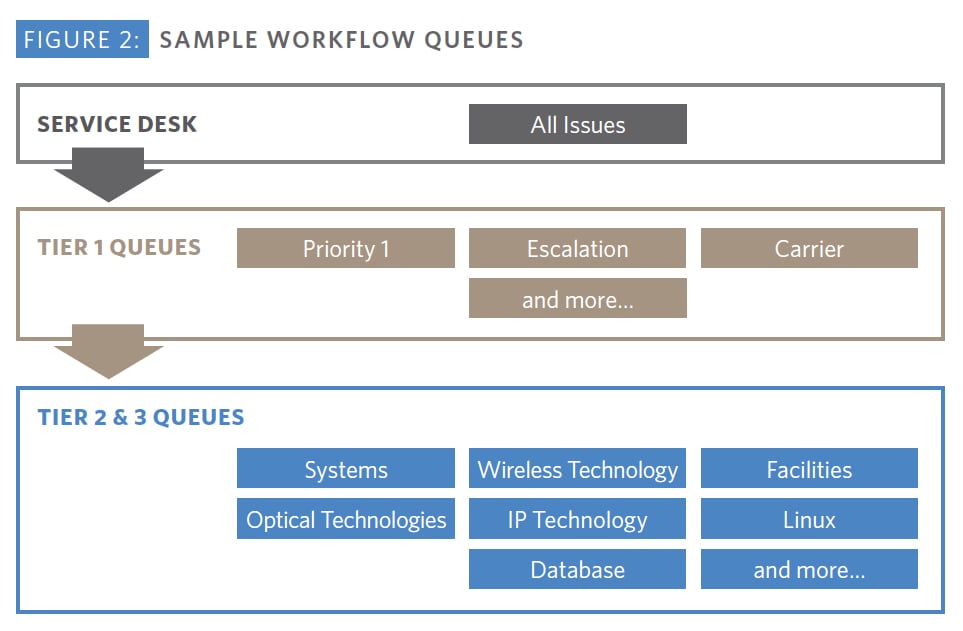
Sample Workflow Queues

These visuals are intended to be instructive in building a framework, but also in realizing the distance between what a NOC should have, and what it actually might have. Especially in NOCs supporting enterprises or communication service providers, the further operations are from a structure like this, the more value it can expect to gain from implementing one.

Talk to us to explore a NOC solution if you're experiencing any of the relevant problem indicators here:

  • Frequent miscommunication and confusion among team members
  • Inefficient incident response times and resolution
  • Inability to effectively manage and prioritize incidents
  • Poor knowledge sharing and collaboration within the team
  • High stress levels and burnout among NOC staff

Challenge #2: Blindness to issues and opportunities due to insufficient operational metrics

Anyone working in a NOC is likely to hear statements like these on a routine basis:

  • “Why are we always busy?”
  • “I feel like we can never catch up,” and
  • “My coworkers are not pulling their weight.”

These sentiments are understandable given the fast-paced environment of a NOC and the constant multitasking that is required. Meaningful operational metrics are vital not only in running a successful NOC but also in keeping staff morale high.

In many NOCs, however, not only are important metrics not being measured—the ones that are being measured aren’t being evaluated on a daily, weekly, and monthly basis. In the case of either or both problems, the early indicators of potential issues will almost certainly go ignored and allowed to evolve into more resource-intensive problems. 

For a quick self-evaluation on this point, consider whether you’re tracking first-call resolution, percentage of abandoned calls, mean time to restore, and number of tickets and calls handled. If you have blindspots in any of these areas, we can almost guarantee there’s an operational vulnerability affecting the NOC’s efficiency or effectiveness. Be aware, however, that this shortlist is by no means exhaustive. Even a brief consult with our Solutions Engineering Team typically reveals a number of metric gaps companies can put on their radar.

Talk to us to explore a NOC solution if you're experiencing any of the common problem indicators here:

  • Difficulty in measuring and tracking NOC performance
  • Inability to identify areas of improvement or inefficiencies
  • Failure to correlate metrics with business outcomes
  • Lack of clarity on the effectiveness of implemented changes
  • Difficulty in setting and meeting performance targets

Challenge #3: High turnover, low morale, and difficulty in hiring, training, and retaining staff due to a lack of a staffing strategy

Great NOCs are a function of great people. But very often, the absence of both a support structure and a skills-based structure can handicap a company’s ability to attract and retain great talent.

Consider the overall activity of your NOC, including the volume of calls, emails, and alarms handled by hour-of-day, day-of-week, and type of support engineer, as well as the duration of incidents. This data should be translated into a working schedule for each type of support engineer needed to satisfy the staffing requirements of your NOC. In addition to using your utilization metrics, benefits, training, and employee growth plans should all be in place.

Read more about the costs, challenges, and key considerations of staffing a 24x7 NOC.

Talk to us to explore a NOC solution if you're experiencing any of the relevant problem indicators:

  • High staff turnover rates
  • Prolonged vacancies for skilled NOC professionals
  • Inadequate training resources and knowledge transfer
  • Low employee morale and job satisfaction
  • Inability to keep up with industry advancements and best practices

Challenge #4: Inconsistent responsiveness to issues or difficulty troubleshooting due to poor/unstandardized process frameworks

A lack of consistency is one of the main reasons NOCs don’t perform at optimal levels.

The best way to achieve consistency is through a standardized process framework. Such a framework provides a NOC with a set of specific procedures for handling various support situations. There are several process and management frameworks to choose from, including MOF, FCAPS, and ITIL.

Process frameworks can be overwhelming when considered in their entirety, so it’s best to tackle areas that challenge the organization the most first. Usually, that’s incident management, problem management, and service desk.

Talk to us to explore a NOC solution if you're experiencing any of these problem indicators:

  • Inconsistencies in processes and procedures
  • Difficulty in onboarding and training new staff
  • Increased likelihood of human error and miscommunication
  • Poor overall network performance and stability
  • Inability to effectively measure and improve processes

Challenge #5: A constant state of vulnerability due to a lack of a business continuity plan

Many NOCs lack a documented plan that outlines the business's functions, identifies the critical systems that enable the organization to operate, and prescribes specific actions to maintain these systems during a disruption. Others have a plan—perhaps limited to disaster recovery only—but don’t adequately protect against all potential disasters and disruptions.

For a quick gap assessment, consider the following essentials for a NOC business continuity plan against your own:

  • Infrastructure redundancy: Regardless of whether your NOC’s data centers are physical or virtual, the disaster recovery plan should include at least two identical data centers running identical software with fully synchronized databases.
  • Operational redundancy: An effective disaster recovery plan should also ensure that the NOC can continue to operate in the event of a site failure.
  • Technical redundancy: Your NOC’s disaster recovery plan should also prepare for a major technical outage that poses a disaster-level threat to NOC service despite affecting only a portion of your facility. Consider scenarios like loss of a single server or network element, loss of much or all of the data center, and loss of a network link.

Challenge #6: Recurring problems and an inability to emerge out of a reactive state due to a lack of quality management

Without continuous quality assurance, NOCs risk hurting customer satisfaction and compromising their reputation. There are two components of quality management in this case: quality assurance and quality control.

A good quality control program monitors and measures primary aspects of the NOC service—the key performance indicators referenced earlier. These KPIs provide much-needed visibility into NOC support activity, responsiveness, and effectiveness. NOC management can use this information to ensure, for instance, that stated objectives for event-to-action times and first-level incident resolution are being met for each customer.

A good quality or service assurance program allows the NOC to identify and resolve problems before they impact customers or the business in a significant way. A quality assurance review begins when a customer reports dissatisfaction with any aspect of the NOC service. NOC management follows up with an internal review of the service—responsiveness metrics, adherence to runbook procedures, customer interaction, and technical troubleshooting, to name a few.

Such quantitative and qualitative measures and the resulting feedback lower the probability of the same problem recurring. Monthly and quarterly reviews of the service with stakeholders ensure that customer expectations continue to be met.

Talk to us to explore a NOC solution if you're experiencing any of these problem indicators:

  • Inconsistent service levels and customer experience
  • Inability to identify root causes and implement corrective actions
  • Lack of a culture of continuous improvement

Challenge #7: Lots of data, but little actionable insight due to disparate tools and platforms

Especially among enterprises and communication service providers, the NOC has to be able to receive and process alarm or event information from multiple sources and present it in a single, consolidated view for staff to act on—a “single pane of glass.”

Without integration between these tools and platforms, NOC personnel are faced with tracking and managing multiple screens for event information; manually collecting information from multiple sources for the purposes of documentation, notification, and escalation; and then attempting to manage workflow toward service restoration. This makes it nearly impossible to monitor and report on SLA metrics, let alone optimize performance. The results inevitably include operational inefficiencies, missed SLAs, and undue stress on staff.

Talk to us to explore a NOC solution if you're experiencing any of these problem indicators:

  • Inefficient troubleshooting and incident resolution
  • Difficulty in monitoring and managing the entire network infrastructure
  • Too much human error and miscommunication
  • Challenges in sharing and accessing relevant information among team members
  • Inability to provide a unified view of the network for decision-making


Challenge #8: Persistent operational problems due to out-of-date documentation and runbooks


Failure to build runbooks, document workflow processes, create structured databases for information storage and retrieval, and record business results for later analysis and optimization will severely impede a NOC's ability to perform effectively over the long term. Too often, services are added and changes are made without proper documentation. This limits the NOC's ability to resolve issues as they arise.

Poor documentation often stems from a lack of resources and the expertise required to map out processes and create work instructions and documents. Instead, key people simply “know what to do” and new staff learn by “seeing and doing” alongside an experienced mentor.

Talk to us to explore a NOC solution if you're experiencing any of these problem indicators:

  • Inconsistent problem-solving approaches among team members
  • Difficulty in training and onboarding new staff
  • Prolonged incident resolution times
  • Increased likelihood of recurring issues
  • Inability to retain and share knowledge within the team

Challenge #9: Business growth stymied due to a rigid, unscalable NOC

Many NOCs aren’t designed to be scalable; that is, able to handle a growing amount of work as the company grows without compromising the level of service.

Typically, business plans include initial funding, sales and marketing, system build-out, operations support, and the business guidance needed to meet the projected growth. What business plans sometimes don’t take into consideration are predictable growth and process planning. The ability to grow or absorb expansion requires careful consideration of staffing, systems and network, tools, process standardization, and training.

Talk to us to explore a NOC solution if you're experiencing any of these problem indicators:

  • Frequent network bottlenecks and performance issues
  • Inability to meet the demands of expanding customer base or service offerings
  • Difficulty in adapting to new technologies or industry trends
  • Inadequate resources to manage growth in network complexity
  • Negative impact on customer satisfaction and business reputation

Challenge #10: Unreasonably high operational costs

Several components drive the cost of operating a 24x7 NOC. Take staff for example. The staff required to support a 24x7 NOC include not only front-line technicians and engineers but also back-end support groups such as systems and network engineering, service transition, human resources, and customer advocacy. 

Resources also need to be allocated for training NOC staff when they are initially hired, as well as when onboarding new customers, and whenever changes are made to existing support or new technologies are introduced. Systems, network connectivity, and security controls must be deployed in either a data center or the cloud to support the NOC's tools and applications. Resources for ongoing support need to be included.

All of these components present a formidable operating expense but have to be considered in building a successful NOC. Too often, NOCs are built with only a subset of the above components, and as a result, they struggle to scale and meet the organization's service and financial objectives.

Talk to us to explore a NOC solution if you're experiencing any of these problem indicators:

  • Increasing expenses without corresponding improvements in network performance or service quality
  • Inefficient use of resources, including staff and tools
  • Difficulty in allocating funds for network improvements or growth initiatives
  • Reduced competitiveness in the market due to high costs
  • Inability to meet financial targets or maintain profitability

Here are a few questions for self-assessment to understand how much you stand to gain from outsourcing NOC support:

  • How would you rate your NOC’s overall service design and operation?
  • If you’re a service provider, have you implemented a service catalog detailing the services your NOC performs?
  • How would you characterize the utilization of your valuable technical resources?
  • Do you use service level management to set your service level agreements and service level objectives?
  • Do you report performance on a regular basis?
  • Do you track changes to your infrastructure and have a change review process?
  • When onboarding new components into your NOC, do you follow a process to review those changes and ensure they are consistent and accurate?
  • What percentage of issues does your Tier 1 response team currently handle, and how does that number make you feel?
  • Do you continually review incidents for opportunities to improve operations and tools?
  • Does your NOC have the appropriate support personnel to assist with process flow, technology, and improvements in responsiveness?

6 What to Look for in a NOC Support Provider

Okay—you’ve weighed the pros, cons, costs, and benefits. You see the advantage of outsourcing your NOC services. Now it’s time to find a service provider best fit for you. When looking for an outsourced NOC partner, look for one who offers a wide variety of customized options. Your needs are unique and your business faces its own set of challenges.

Here are a few of the major components and qualities you’ll want to see in your service provider.

1. A tiered organization and workflow

As we mentioned earlier, the structure is essential to the success of a NOC. Does a prospective NOC service provider bring this to the table? For example, here at INOC, our support framework typically reduces high-tier support activities by 60% or more, often as much as 90%. 

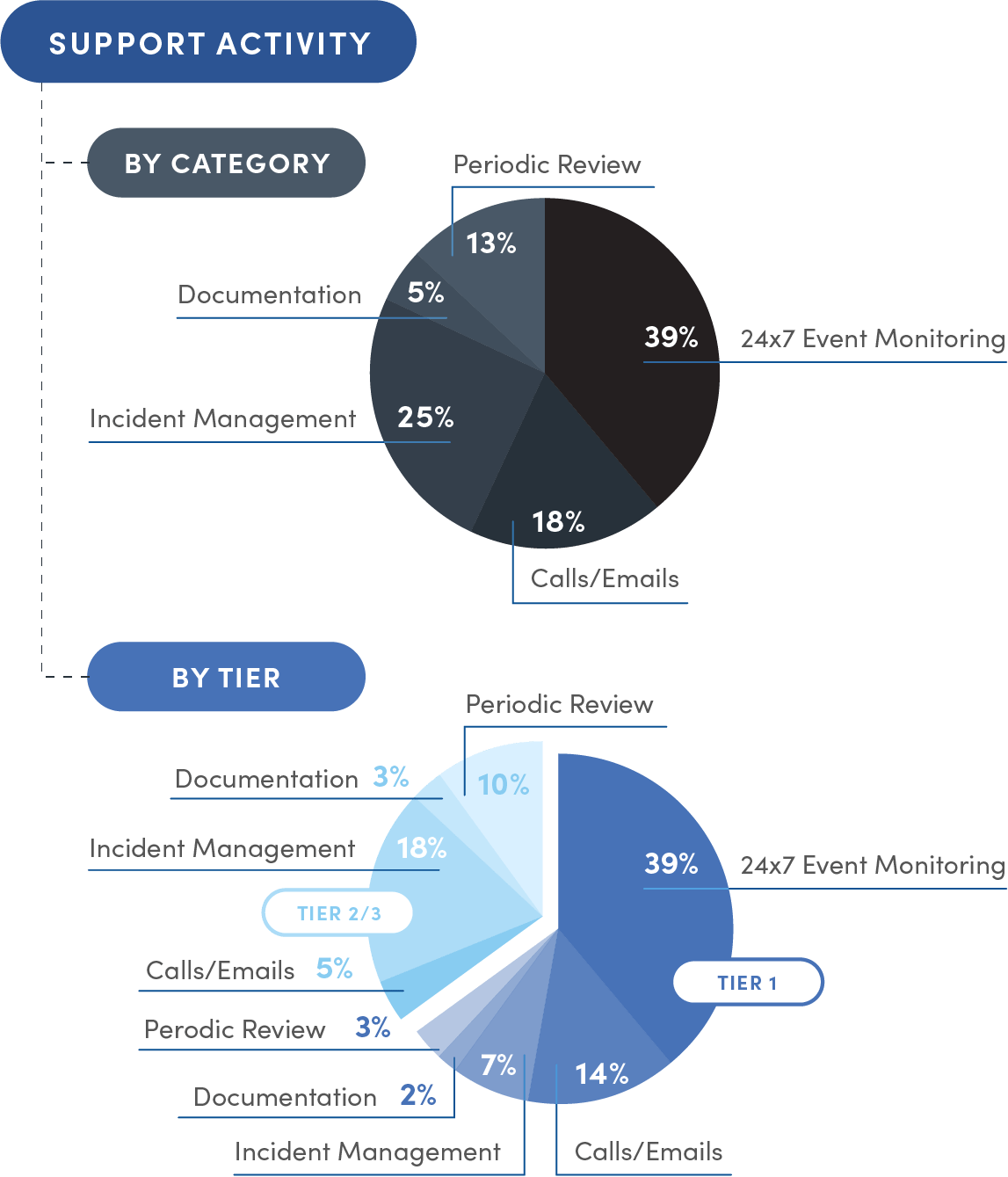
Graphic Support Framework

The Structured NOC, as we call it, radically transforms where and how support activities are managed—both by tier and category. In a matter of months, the value of this operational framework becomes abundantly clear as support activities steadily migrate to their appropriate tiers as shown in the breakdown above. This lightens the load on advanced engineers while working and resolving issues faster and more effectively.

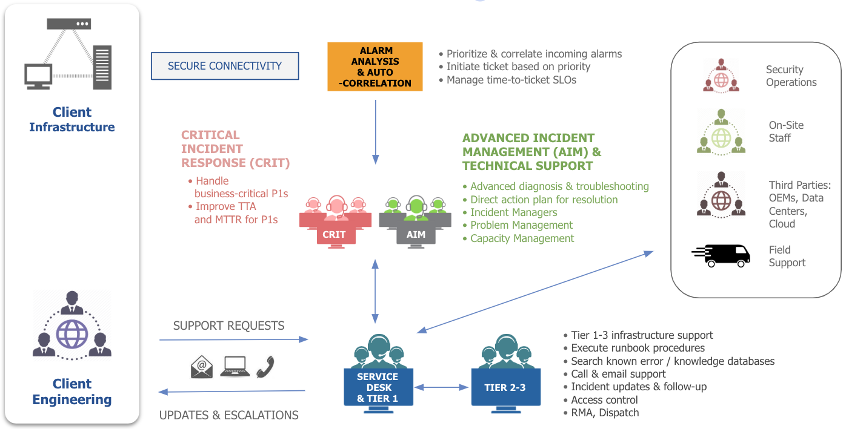
INOC utilizes its automation capabilities, operational workflows, and NOC expertise to drive efficient incident resolution and service reliability. Figure 3 illustrates the structured workflow between the various teams in the INOC NOC environment.

Incident triage and resolution are handled by INOC’s Advanced Incident Management (AIM) team, which formulates a structured action plan for service restoration. Achieving aggressive response and resolution SLAs requires precise initial diagnosis, which is facilitated through a streamlined NOC workflow as shown below.

INOC workflow

INOC's tiered NOC team structure is designed to enable rapid incident response and advanced troubleshooting:

  • Critical Incident Response Team (CRIT): Manages business-critical Priority 1 incidents, minimizing impact and restoring services as quickly as possible while ensuring fast Time to Action (TTA), Mean Time to Repair (MTTR), and other key Priority 1 performance metrics
  • Advanced Incident Management (AIM) Team: Specializes in advanced diagnosis, root cause analysis, and incident resolution strategies, developing detailed action plans for execution by Tier 1 NOC personnel
  • Tiered Support Teams: INOC's tiered structure ensures incidents are handled at the appropriate level of expertise, with Tier 1 providing frontline support, Tier 2 composed of mid-to-senior level engineers, and Tier 3 including senior-level engineers with expertise in complex infrastructure design and implementation

Our Tier 1 and AIM teams collectively resolve 70% to 85% of incidents using standardized, templatized support processes. Our support framework typically reduces high-tier support activities by 60% or more, often as much as 90%.

This structured approach radically transforms where and how support activities are managed—both by tier and category. In a matter of months, the value of this operational framework becomes abundantly clear as support activities steadily migrate to their appropriate tiers. This lightens the load on advanced engineers while working and resolving issues faster and more effectively.

2. A support system for the NOC itself

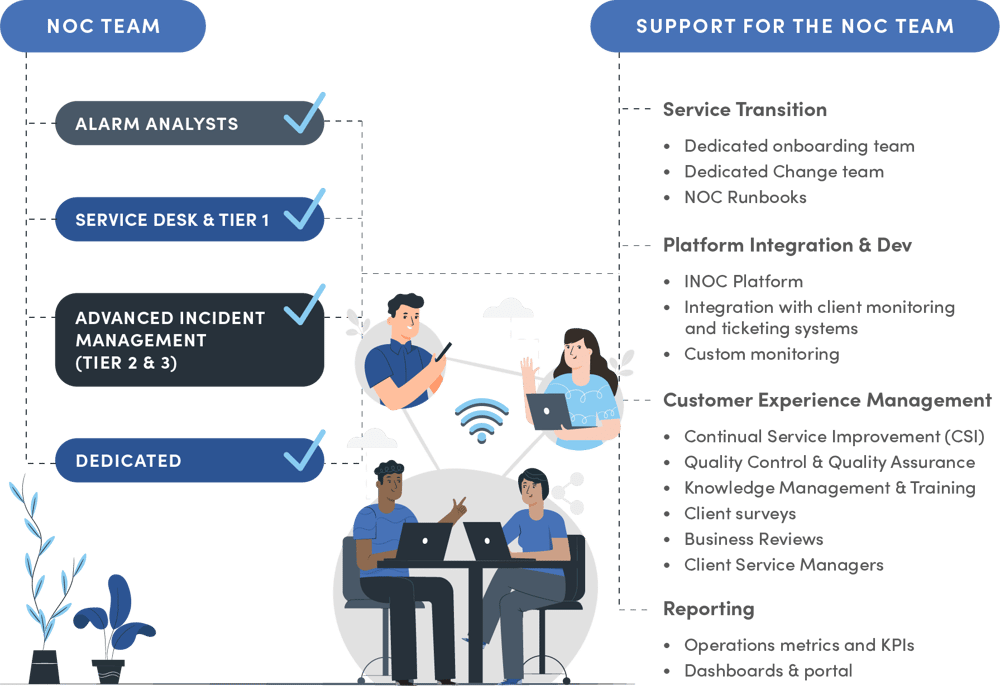
24x7 support requires more than a fully staffed NOC. Each activity that surrounds NOC support, including onboarding, tools integration, and reporting (just to name a few), requires a dedicated team that can put experience and best practices to work for you.

Success in NOC support is a combined effort between the NOC team and the critical teams supporting it. Here at INOC, for example, the INOC Team encompasses all of these roles and functions, giving you a complete support package from initial service transition to close-knit customer experience management (and everything in between).

support for noc

A few of our support units include:

  • Project Delivery Office: Oversees new client onboarding and service transitions through Project Managers, Onboarding Specialists, and a Change Team
  • Platform Team: Developers, engineers, and system specialists dedicated to supporting INOC's platform and managing complex client integrations, including compute and cloud services
  • Reporting Team: A dedicated analytics team responsible for tracking, analyzing, and updating performance metrics and KPIs
  • Quality Team: Focused on ensuring service excellence through quality control and assurance processes, knowledge management, staff training, client satisfaction surveys, and dedicated Client Service Managers
  • Professional Services Team: Provides customized support solutions including runbook development, tools integration, infrastructure setup, and provisioning support
  • Security Advisory Board (SAB): A governance body led by INOC's ISMS manager maintaining our cybersecurity framework and ensuring ongoing compliance

3. A workflow enhanced by machine learning and automation (AIOps)

Most NOCs generate more data than they know what to do with. Much of this data is begging to be analyzed as it contains incredibly useful information that could dramatically improve the speed and quality of support. But without the powerful analysis capabilities needed to intelligently sift through all of that data, NOCs are forced to leave those insights locked away—leaving huge opportunities on the table.

AIOps—Artificial Intelligence for IT Operations—uses big data, analytics, automation, and machine learning capabilities to unlock the insights contained within massive amounts of data generated across an environment. It can then use those insights to identify and automate low-risk tasks in the NOC. With vastly superior data processing and machine learning power, the NOC can perform correlation much faster and identify the subtle indicators of approaching issues within a torrent of mostly noisy data.

Especially in enterprise or similarly complex environments where incidents and events need to be correlated across perhaps three, four, or five different monitoring platforms, successfully supporting multiple enterprise clients requires the advanced analysis and interpretation capabilities only AIOps can offer. As far as we know, we’re so far the only NOC support provider applying powerful AIOps capabilities to the NOC operations environment—consolidating and correlating data from disparate systems and providing remarkable intelligence for better, faster support. 

📄 Grab our free white paper, The Role of AIOps in Enhancing NOC Support, to learn how your NOC support stands to gain from AIOps. Use the free included worksheet to contextualize the value of AIOps for your organization. 

4. A highly integrable support platform

Complex environments that require support for multi-vendor, multi-technology IT stacks need an outsourced NOC support partner who can augment and build on any current IT support capabilities with integrations without disrupting your operation.

Here at INOC, for example, our platform offers a wide array of existing system integrations developed over many years, as well as the flexibility to integrate with virtually anything you or your customers may use. Building a homegrown platform integrable enough to connect to multiple enterprise environments is an incredibly difficult feat requiring extremely rare operational and technical expertise. 

Whether it’s a monitoring tool, ticketing system, or anything else, your NOC provider should have the knowledge, procedural flexibility, and platform capability to integrate with your customers’ operations and toolsets without creating new problems and risks.

Reducing MTTR through AI, CMDB, and high-quality support

INOC's Operations Platform is designed to optimize response workflows, improve incident prioritization, and reduce Mean Time to Repair (MTTR) by leveraging AIOps and GenAI:

  • AI-driven event correlation consolidates multiple related alarms into a single incident ticket, reducing ticket noise and allowing NOC engineers to focus on the most critical issues
  • GenAI-powered ticket summarization enables NOC engineers to quickly grasp an incident's history, previous actions taken, and pending tasks, eliminating the need for manual ticket reviews and streamlining handoffs between teams and shifts
  • Comprehensive CMDB built following our Gold Standard CMDB architecture, continuously validated with clients to maintain data integrity regarding business impacts, contact details, and escalation procedures

With accurate CMDB data—including device, service, location, and topology mapping—impact assessments can be conducted at ticket creation, even before a NOC engineer engages. This enables:

  • Faster triage and resolution by accelerating root cause analysis through pre-correlated event data
  • Enhanced automation-assisted remediation to minimize manual intervention
  • Improved vendor coordination by providing precise diagnostic details upfront
  • Service-specific incident notifications sent to client stakeholders detailing outages, performance degradations, and planned maintenance

INOC continues to invest in AIOps and GenAI, enhancing our automation, analytics, and response workflows to drive faster incident resolution and improve service efficiency.


5. A highly integrable support platform

Complex environments that require support for multi-vendor, multi-technology IT stacks need an outsourced NOC support partner who can augment and build on any current IT support capabilities with integrations without disrupting your operation.

INOC's platform offers a wide array of existing system integrations developed over many years, as well as the flexibility to integrate with virtually anything you or your customers may use. Our three flexible support model options ensure we can work within your environment:

  1. Using INOC Platform 3.0 exclusively
  2. Using INOC Platform 3.0 while adhering to your existing tools and strategy (no modifications required)
  3. Operating exclusively within your existing toolset

Whether it's a monitoring tool, ticketing system, or anything else, INOC has the knowledge, procedural flexibility, and platform capability to integrate with your operations and toolsets without creating new problems and risks.

Supported systems include, but are not limited to:

  • Network: Switches, access points, routers, and firewalls (supporting most OEMs and models)
  • Compute: Physical servers, virtual machines, cloud infrastructure, databases, and applications
  • Telephony: Physical, cloud-based, and web-integrated platforms

INOC has achieved multiple OEM designations, including Cisco Platinum Partner, Juniper Networks Elite Plus Partner, and Microsoft Cloud Solutions Platinum Partner, reinforcing our expertise in delivering high-quality support solutions.

6. A 24x7 service desk

The service desk is the single point of contact for you and your customers. All phone calls, emails, and other alerts are processed into incidents and requests before being dispatched to the appropriate personnel based on your desired level of technical support. 

Since enterprises and other large organizations need all kinds of support around the clock, it’s important to ensure your service provider has a 24x7 service desk for notification, tier one, or more advanced NOC support based on your specific needs.

7. A comprehensive and flexible approach to Service Level Management (SLM)

Complex support services often require more than standard SLAs. You or your customers should have the flexibility to choose which service levels reflect actual measures for success. Your NOC service provider should then help you assemble the SLM package that reflects the specific demands of your IT environment while balancing business goals and budget.

At INOC, for example, we take service level measurement to the next level. In addition to standard KPI reporting, which includes monthly SLA measurements, we deliver an array of additional SLOs to better measure performance and keep both teams aligned on success.

8. Continual service improvement delivered through a broader Customer Experience Management program

Enterprise customers demand the highest standards for quality support. Your support provider should be prepared to build out not just a NOC, but a support operation to continually improve it. 

Here at INOC, for example, our dedicated quality control and assurance programs maintain proactive and reactive checks on virtually every service component we provide. These quality measures come together with next-level reporting capabilities to deliver the comprehensive Continual Service Improvement only an operationally mature IT organization can deliver on.


9. Service portal access and real-time bisibility

INOC's Service Portal provides clients with real-time access to tickets, runbooks, knowledge articles, and reports. The portal offers live dashboards and analytics, with both standard and custom reporting powered by ServiceNow and Tableau. This enables clients to monitor incident trends, SLA adherence, and operational performance metrics in real time.

10. A robust security and compliance framework

INOC maintains a comprehensive security framework anchored in ISO 27001:2022 certification, ensuring compliance with globally recognized security standards:

  • Employee Background Checks: All employees undergo 7-year background screening before employment
  • SOC 2 Type II Certification: INOC maintains dual primary data centers that meet strict SOC 2 Type II compliance standards
  • Complete Client Separation: Dedicated network segmentation for each client with isolated servers, databases, and reporting environments
  • Dedicated Security Team: Specialized administrative and technical security personnel overseeing policy enforcement and risk management

7 What to Expect Before, During, and After Onboarding

Organizations considering outsourcing their NOC support often wonder what the process of transitioning or turning up service looks like and what to expect before and after. While this process may look different from one organization to another, in general, a capable NOC support provider will first conduct an assessment to learn precisely how the service needs to be established and operationalized. Then they prepare services according to the needs they identified and work with the client to turn up services after a diligent testing phase. 

Once service is operational, the provider should shift to optimization mode. This means employing quality control and assurance, along with other customer experience management activities, to constantly re-examine what’s working, what’s not, and make ongoing, incremental improvements to their processes while keeping service aligned to the business’s changing needs.

To unpack the onboarding process further, we’ve broken down the general expectations at the “before,” “during,” and “after” stages.

Before onboarding: Assessment and service preparation

When outsourcing NOC support, the first step should always be the same: stepping back to analyze the business, your customers, and the support requirements ahead of you. This initial analysis enables your service provider to gather all the information needed to design the services in a way that strikes the perfect balance of capability and efficiency. The findings of the questions you can expect to be asked should directly inform the NOC’s organization and operationalization across all three essential elements: people, process, and platform. 

This assessment, or business analysis, has four main components:

  1. Gathering your support requirements (and/or those of your customers): It’s critical to start by understanding who and what will be supported in as much detail as possible. This first step of gathering support requirements helps characterize the state of your existing support function to identify gaps in capability or problems related to performance and sustainability. Existing issues might be well-known, such as staff fatigue or technology gaps. Other issues may be off the radar entirely, like the critical but generally under-appreciated area of business continuity.
  2. Determining necessary or desired service levels: Once your service provider knows exactly what they’ll be supporting, they should work closely with you to understand the service levels that govern that support. Here at INOC, for example, we employ a process for analyzing service level management (SLM) to determine proper staffing levels, what tools will need to comprise the NOC platform, and how success should be measured. An SLM analysis is essentially a performance review of a service as it exists now to determine what it needs to include going forward.
  3. Determining the metrics the NOC will need to measure: This component of the analysis examines what’s currently being measured and how that reporting is contributing to the quality of support being provided. The findings should reveal what’s working, what’s not, and what changes should be made to ensure that the right metrics are tracked and reported. A capable NOC service provider should ask you how NOC effectiveness and customer satisfaction are currently being measured, and what those metrics—or lack thereof—say about the state of support being provided in order to retain current strengths and seize opportunities to improve.
  4. Determining the total cost of ownership: In the context of new NOC service, the two most prominent figures factoring into the TCO are establishing and maintaining the platform and labor cost to support it. 

During onboarding: turning up service

Reaping the benefits that come with a highly capable, operationally mature NOC without having to endure the typical onboarding headaches requires a well-defined process and a commitment to adhere to it. It also means committing to diligent communication at each stage, ensuring both sides are clear on what’s happening and when.

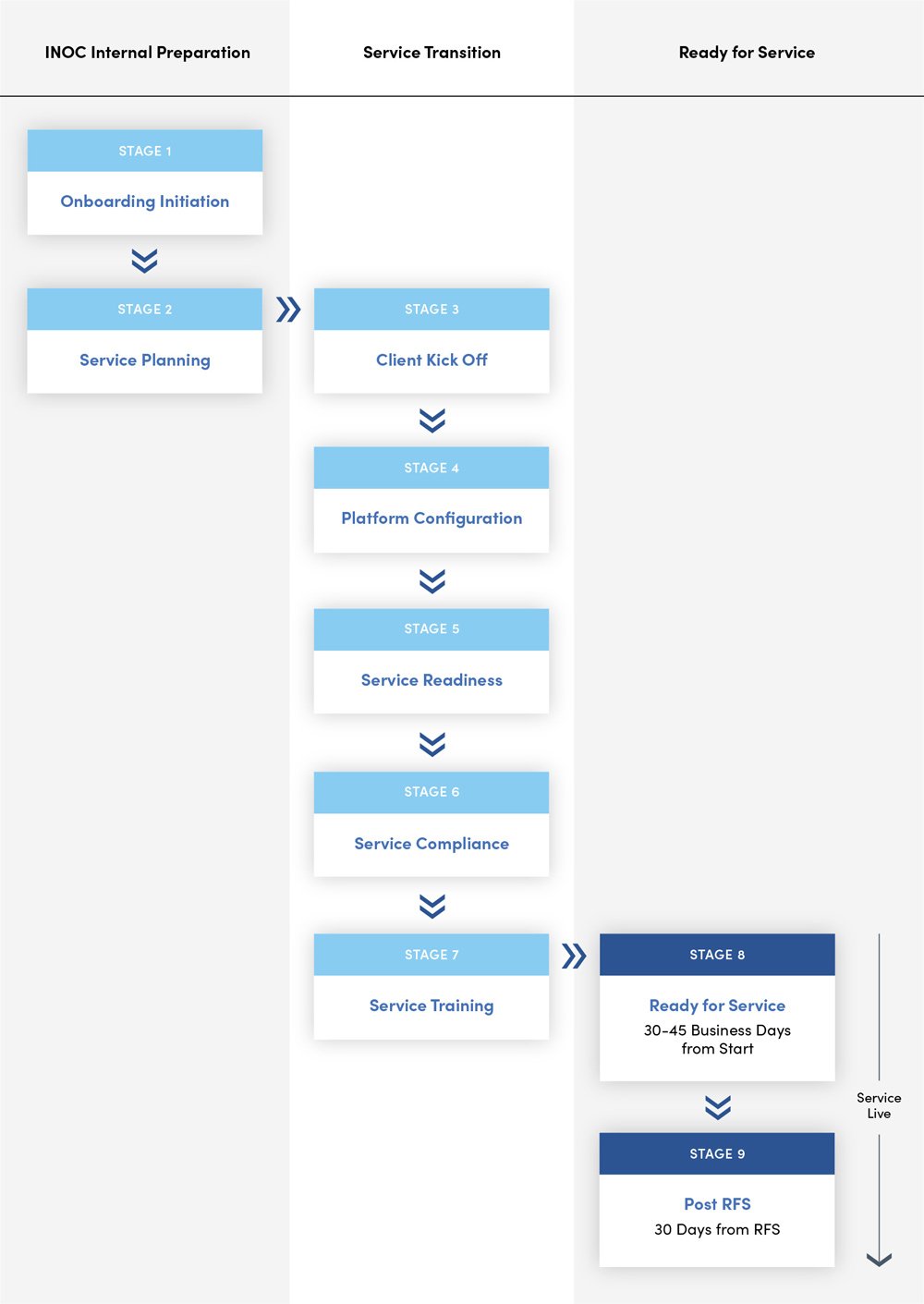
Here at INOC, we’ve invested a lot of time and energy into developing and refining an onboarding process that ensures a successful transition to outsourced NOC service without creating headaches and needlessly time-consuming work. The process graphic below offers a look at the nine steps we take to onboard new NOC clients.

Read our post, Onboarding Outsourced NOC Support: 9 Steps to Success, for a deeper dive into what you can expect as a client going through this process and tips you can use to prepare accordingly.

client onboarding

Since onboarding is such a critical step in transitioning to third-party NOC support, be sure the service provider you trust with protecting and optimizing your infrastructure offers a dedicated service turn-up team that walks you through our process with helpful tools to keep everyone aligned. 

In terms of a timeline for service transition, we typically get clients up and running on our award-winning NOC in four to eight weeks. Once you’re up, you should also be given access to a client portal to see what the NOC is tracking in real-time. Access to actionable metrics helps both teams benchmark performance and determine the root cause of ongoing issues for more effective resolution and prevention.

After onboarding: Change Management, Continual Service Improvement, and Customer Experience Management

Once NOC service is officially turned up and running optimally, your NOC service provider should transition you from a focus on onboarding to Change Management and Continual Service Improvement as part of its broader Customer Experience Management program.

Its Change Management specialists should have robust processes to both proactively check in on and reactively field notices of changes in your environment so they can be effectively managed in the NOC. Your NOC provider should also put ITIL’s Continual Service Improvement principles into practice—constantly looking for ways to:

  • Assess the NOC’s ongoing success in delivering effective ITSM
  • Ensure that the IT service catalog is continuously aligned with current and future business needs
  • Identify and act on opportunities to improve each service, thereby optimizing speed and effectiveness while boosting process maturity

Your service provider should be able to demonstrate quality control and assurance measures that work proactively to keep most concerns off your radar entirely. Here at INOC, for example, we pull large samples of both specific and random tickets to understand how they were created, worked, and closed to learn from successes, identify opportunities for improvement, and understand any potential impact on service.

Read our post, ITIL CSI: A Guide and Checklist for IT Support and the NOC, for a deeper dive into why CSI is critical in the NOC and what to look for in a prospective service provider.

A Few Key Considerations

  • Make sure any prospective NOC service provider begins their service engagement with an assessment commensurate with the level of support they’ll be providing.
  • Make sure any prospective NOC service provider has a documented and well-resourced process. 
  • Is the CSI team trusting or challenging their assumptions about the need and nature of improvement opportunities?
  • Is the CSI team conducting research and working cross-functionally to better understand the best way to make improvements?
  • If CSI is entrusted to an outsourced NOC support provider, are they working directly with you, their client, to gather information, develop a strategy, and set expectations?
  • Is the CSI team clearly defining desired outcomes so they can definitively validate an improvement’s success or failure?
  • Does the NOC have the data repositories and metrics established to both collect the right reporting data to avoid red herrings and provide reliable benchmarks for measuring improvement results?
  • Is the CSI team setting quantifiable measurements for success?
  • Is CSI guided by a documented plan that helps all impacted parties communicate and understand expectations?
  • Does CSI go above and beyond ITIL’s best practices to deliver a higher level of Customer Experience Management?

See some room for improvement? Get in touch and let's discuss possible solutions.

8 Key Questions to Ask Yourself and a Prospective NOC Provider

Questions for self-assessment—how much do you stand to gain from outsourcing NOC support?

  • How would you rate your NOC’s overall service design and operation?
  • Have you implemented a service catalog detailing the services your NOC performs?
  • How would you characterize the utilization of your valuable technical resources?
  • Do you use service level management to set your service level agreements and service level objectives? Do you report performance on a regular basis?
  • Do you track changes to your infrastructure and have a change review process?
  • When onboarding new components into your NOC, do you follow a process to review those changes and ensure they are consistent and accurate?
  • What percentage of issues does your Tier 1 response team currently handle, and how does that number make you feel?
  • Do you continually review incidents for opportunities to improve operations and tools?
  • Does your NOC have the appropriate support personnel to assist with process flow, technology, and improvements in responsiveness?

Questions for assessing prospective NOC service providers—do they have what it takes to deliver outstanding support?

  • Do they provide full-service 24x7 support?
  • Is their NOC based in the United States or overseas?
  • Are NOC services this provider’s primary business or is it supplementary to something else?
  • Do they offer both shared and dedicated support models—thereby enabling economies of scale or the dedicated resources we need?
  • Will their NOC platform integrate with our existing tools and infrastructure without forcing changes upon us or creating risk?
  • Can they demonstrate success in supporting organizations like ours?
  • Do they have an adequately comprehensive business continuity plan and redundancy in place?
  • Do they offer a robust client portal with convenient visibility into the state of our support?
  • Do they offer runbook development services and manage runbooks as a component of service?
  • Are alerts and escalations handled in a way that doesn’t disrupt our current operations?
  • Do they offer a full service catalog?
  • Does their speed and effectiveness in detecting, diagnosing, and remediating issues reflect our needs?
  • Will they open and manage vendor and carrier tickets?
  • How fast can they establish service? 
  • Is the outsourced NOC price fixed, tiered, or will it vary with usage?

Considering outsourced Support? Let’s Talk NOC.


Connect with us to take the first step in unlocking the full potential of your IT infrastructure and keeping it running 24x7.

Have questions? Want to learn more about building, optimizing, or outsourcing your NOC?

Our NOC solutions enable you to meet demanding infrastructure support requirements and gain full control of your technology, support, and operations. Choose the appropriate next step below to get in touch with us or get the resources you need to inform your decision-making.

Book a free NOC consultation

Connect with an INOC Solutions Engineer for a free consultation on how we can help your organization maximize uptime and performance through expert NOC support.

Our NOC consultations are tailored to your needs, whether you’re looking for outsourced NOC support or operations consulting for a new or existing NOC. No matter where our discussion takes us, you’ll leave with clear, actionable takeaways that inform decisions and move you forward. Here are some common topics we might discuss:

  • Your support goals and challenges
  • Assessing and aligning NOC support with broader business needs
  • NOC operations design and tech review
  • Guidance on new NOC operations
  • Questions on what INOC offers and if it’s a fit for your organization
  • Opportunities to partner with INOC to reach more customers and accelerate business together
  • Turning up outsourced support on our 24x7 NOC

Contact us

Have general questions or want to get in touch with our team? Drop us a line.

Free white paper

Download our free white paper and learn how to overcome the top challenges in running a successful NOC.


*Originally developed by the UK government’s Office of Government Commerce (OGC) - now known as the Cabinet Office - and currently managed and developed by AXELOS, ITIL is a framework of best practices for delivering efficient and effective support services.

Contributors to the guide

prasad ravi
Prasad Ravi

Co-Founder/CEO, INOC

prasad rao
Prasad Rao

Co-Founder/President/COO, INOC

Jim Martin
Jim Martin

VP of Technology, INOC

hal baylor
Hal Baylor

Director of Business Development, INOC

Ben Cone
Ben Cone

Senior Solutions Engineer, INOC

Liz Jones-Queensland

Communications and Learning Manager, INOC