

Most NOC proposals say close to the same things. Around-the-clock coverage, yntegration with tooling, SLAs, etc. Ten years ago a few of those lines meant something. Everyone has since learned to write them, which means the proposal has stopped being a useful way to tell providers apart.
I spent several years buying this service before I came to work on the delivery side of it. What I got wrong back then was reading proposals as descriptions of an operation. They're descriptions of an intention.
The distance between those two things is where service quality lives, and you can measure that distance during evaluation if you ask questions that have hard answers.
Here is what I would look at.
How They Define Service Tiers
Tiering often looks like an org chart question. It's a question about labor.
One large financial services company came to us after years with a provider that classified almost all of its work as Tier 3. On paper, that reads like a sophisticated shop staffed with senior engineers. In practice, it meant tickets went back to the client's own engineers for anything past acknowledgment, while the monthly report showed good numbers, because the provider was only measuring the work it kept. The client was paying for a NOC and running one at the same time.
So ask for the split.
-
What share of incidents close at Tier 1 with no escalation?
-
What share leave the NOC and land on your team?
A provider with a disciplined Tier 1 function has both numbers and will not need to go find them. Across our operation, first-level resolution runs above 85 percent. In one long-running client environment, roughly 70 percent of incidents are resolved in the NOC without escalating anywhere.
Then ask the follow-up most people skip: what does Tier 1 actually do besides acknowledge? If the answer amounts to watching a screen and forwarding alarms, you are buying a notification service and calling it a NOC.
At INOC, we've spent years developing what we call the Structured NOC. It's the operational framework we use to deliver 24x7 support across all client environments.
The diagram below shows how it's organized.
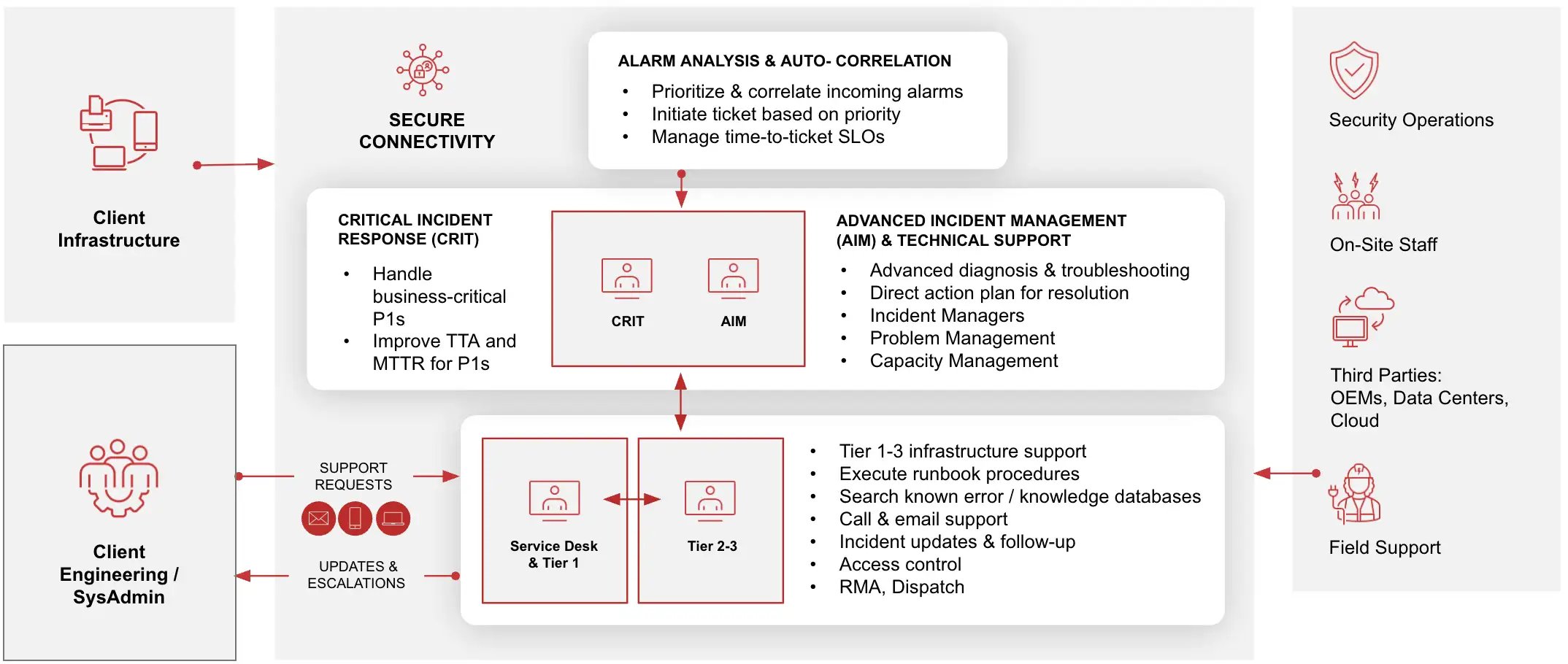
The structure has distinct operational layers, each with a defined scope of responsibility, and clear routing between them.
- Alarms enter from the top.
- Support requests enter from the bottom left.
- Everything flows through defined paths to the right people at the right tier.
If and How They Correlate Alerts and Events
Everybody monitors. What separates NOC operations is what happens between the alarm and the ticket.
Without a correlation layer, one fiber cut or one failed switch can produce dozens of alarms and, in plenty of operations, dozens of tickets. Your engineers then spend the opening stretch of the incident working out that all of it is the same incident. Automated ticketing on its own makes this worse. It industrializes the noise.
Two numbers describe a correlation engine better than any architecture diagram:
-
How many alarms arrive per ticket created
-
What portion of events close automatically with nobody touching them
Ask for both! In our operation, roughly half of events auto-close with no human intervention, and correlated tickets are generated in under a minute.
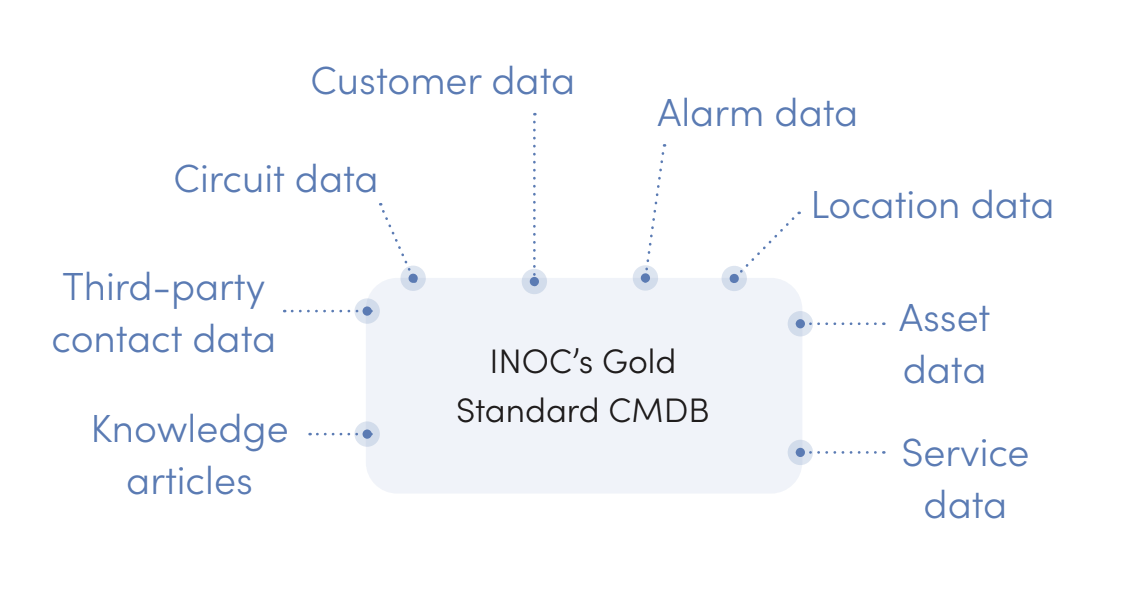
Also, ask what feeds the correlation. A system that only reads alarm patterns is weaker than one that also reads the CMDB and knows which devices depend on which, which site is affected, who to call, and what was done the last three times this happened.
Falling ticket volume is a legitimate outcome here, not a sign of missed coverage. Two of our clients saw volume drop by 20 and 50 percent after correlation was tuned to their environments.
Read our CMDB guide for a deeper dive on developing a NOC-focused system here.
Accurate, Comprehensive Performance Reporting
Ask for a real client report with the names taken out. Not a dashboard mock-up from the deck.
Then read it for absences. The report that financial services client had been getting looked strong because it measured the provider's response time on the tickets the provider chose to keep. It did not measure how long the full incident took to resolve, and it did not count what got handed back. Both parties could read that report every month and reach opposite conclusions about whether the service was working.
A serious provider measures across the whole incident rather than its own slice of it:
-
Time to notify
-
Time to acknowledge
-
Time to restore
-
Time to root cause
-
Time to problem resolution
Plus all of the change management equivalents.
Ask which of those get reported by default, which are contractual, and what happens when one is missed. "We would have a conversation about it" is a different answer from a documented improvement register with an owner and a date on it.
Here's just a small sample of our typical reporting:
Service KPIs and ticket trends (like Time to Ticket)
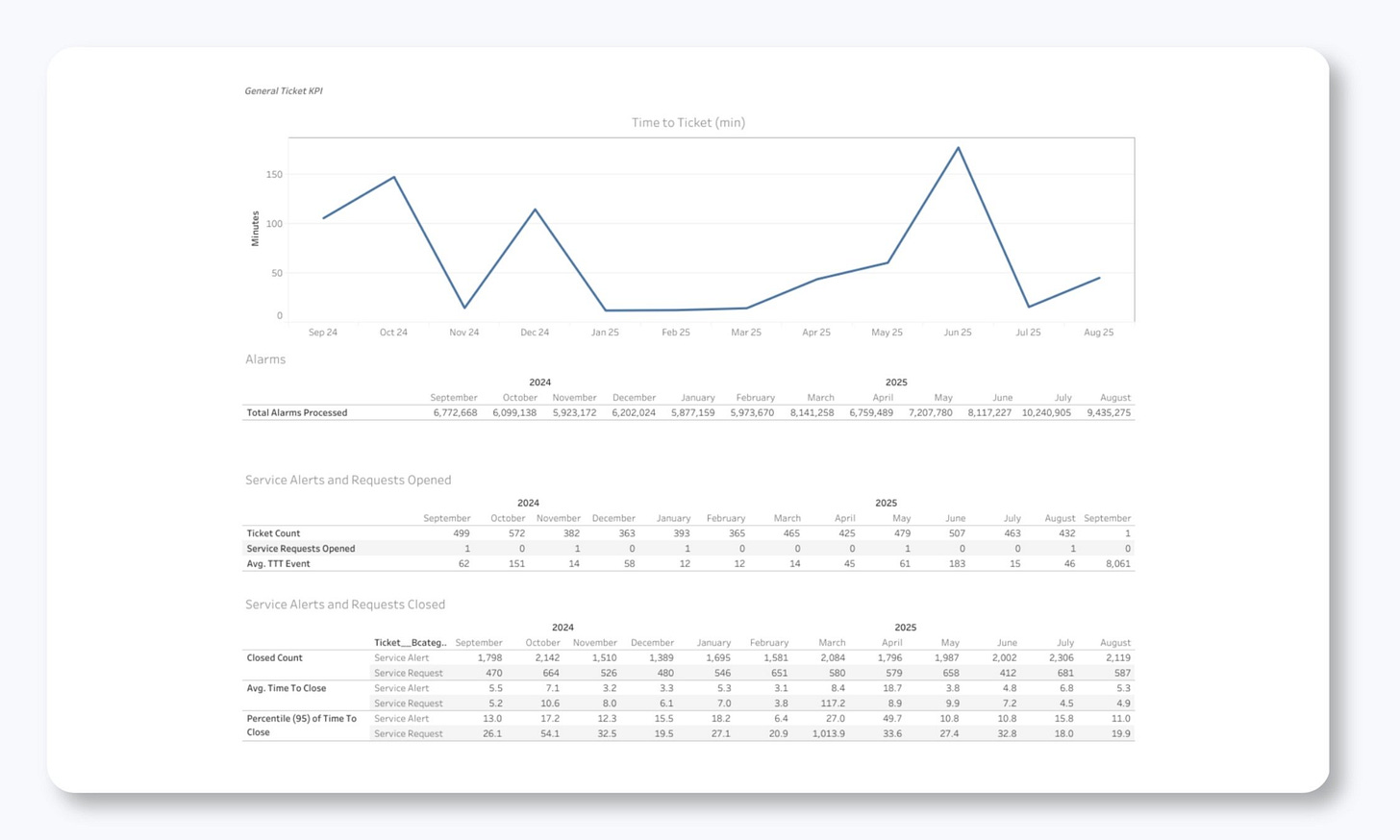
The first screen most teams open shows tickets opened and closed over the past several months, the current open count, and a breakdown by type: monitoring, change, problem, and so on. This is the basic reporting every NOC should have or provide.
Closed incident by resolution category and sub-category
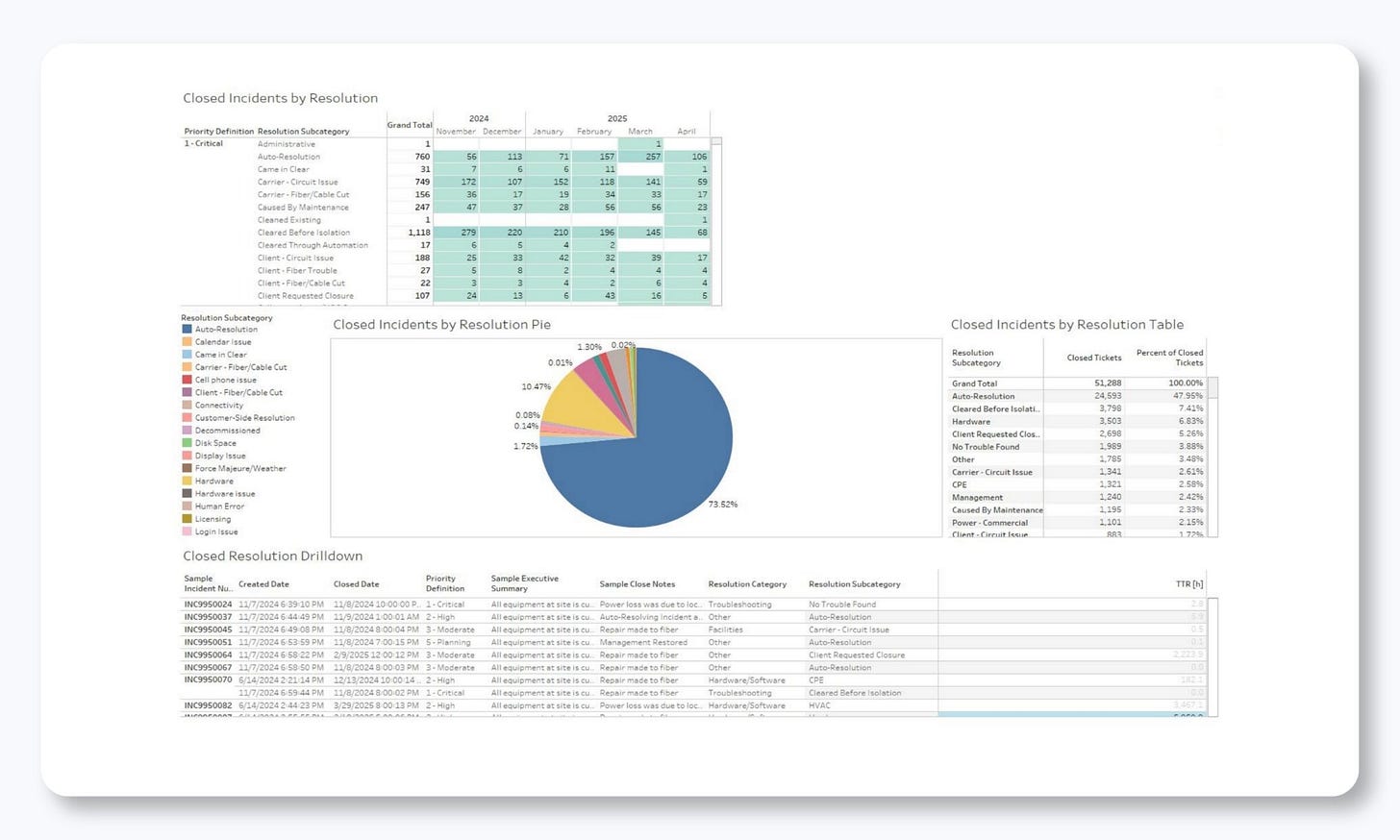
Every closed incident in our system gets a resolution code. Aggregate those over a few months and chronic problems stop being anecdotes. One carrier sitting behind a third of your P2 tickets over two quarters should be a vendor conversation with evidence attached (and vendors negotiate differently when you bring the data).
Monthly ticket report
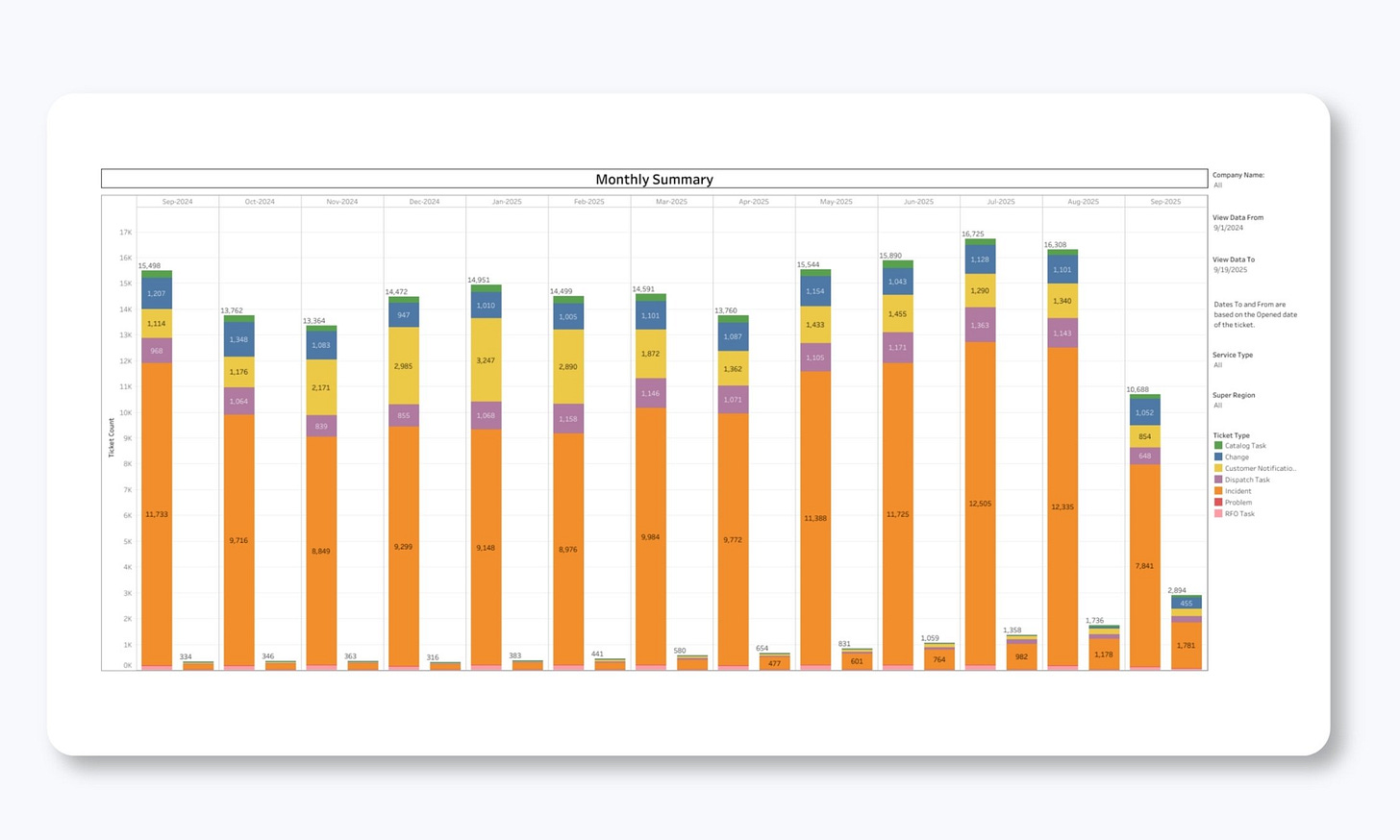
Our monthly ticket report gives a detailed breakdown by ticket type and open/closed status. This report includes full drill-down capability, so you can click any data point to see the actual tickets that make up that number.
This transparency is critical! You’re never wondering what’s behind a statistic, which is one of the prime complaints we hear about prior NOC service providers: the numbers look good, but service feels poor.
A Defined Onboarding Process
Everything else here is a claim about how a provider behaves under pressure. Onboarding is the one thing you can inspect in detail beforehand, because it is a project, and projects have plans.
Ask for the phase plan with durations and named roles.
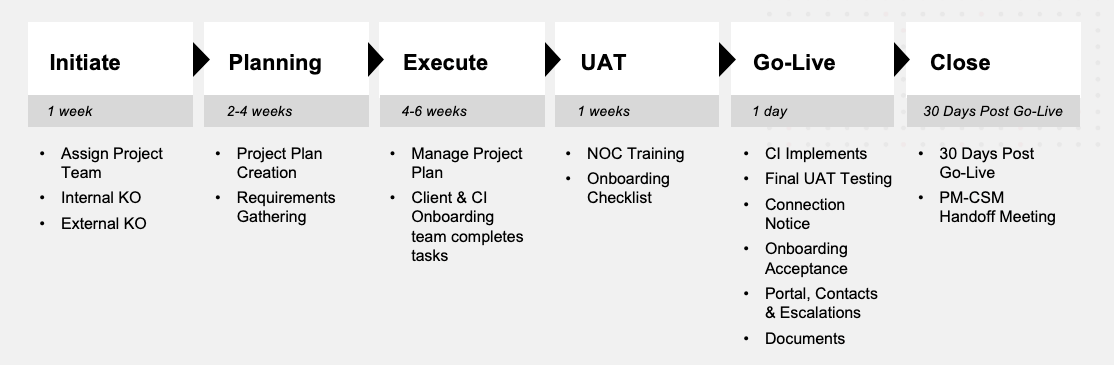
Ours runs about a week to initiate and assign the team, two to four weeks of planning and requirements gathering, four to six weeks to execute and train the NOC on your environment, a week of user acceptance testing, then thirty days of structured review after go-live before the project manager hands the account to the client services manager.
You get a project manager, an onboarding specialist, a solutions engineer, an account manager, and a client services manager, and you should know which one to call for what.
You do not need those specific numbers. You need somebody's numbers, in writing, with names attached. A provider who cannot produce a phase plan during evaluation will not produce one after the contract is signed.
An Actual Staffing Strategy
Attrition is the figure most providers will not volunteer, and it determines whether the engineers who learn your environment are still there in eighteen months. Attrition in this line of work commonly runs 30 to 40 percent.
Ask what theirs is, ask how they calculate it, and ask what the career path looks like from Tier 1, because that path is the mechanism that keeps the number down.
Ask about certifications by count and type. Ask where staff physically sit and whether that is negotiable. If you are in a regulated environment, ask about ISO 27001 certification and get the certificate rather than the logo.
One question that rarely comes up and should: can the provider absorb your existing team? If you have people who know your environment cold and you are outsourcing partly to reduce management overhead, a structured staff transition keeps that knowledge in the building instead of walking it out the door. We have done this. Not every provider will!
What Buyers Tend to Get Wrong About Their Own Operation
When organizations rate their own operational maturity, most say they are doing fine. In our consulting assessments, using a capability maturity model, the scores come back consistently between one and two out of five.
Most teams aren't sure what maturity means in this context because they're getting by. They have a ticketing system. Someone picks up at 2 a.m. It works, more or less, until the week it doesn't. The perception usually shifts during the first real assessment conversation, when somebody walks through what the operation could look like and the gap turns concrete.
This is an argument for treating evaluation as a diagnostic rather than a procurement exercise. The questions above will tell you a good deal about the providers you are talking to. They'll also tell you something about your own operation, and that second answer is often the more useful one.
Working through this against your own environment? Get in touch and we can walk your requirements. If you want to start with your current operation instead of a vendor list, our NOC operations consulting practice runs the assessment described above.
Free white paper A Practical Guide to Running an Effective NOC
Download our free white paper and learn how to build, optimize, and manage your NOC to maximize performance and uptime.

-images-0.jpg?height=2000&name=ino-WP-NOCPerformanceMetrics-01%20(1)-images-0.jpg)




-images-0.jpg?width=200&height=259&name=ino-WP-NOCPerformanceMetrics-01%20(1)-images-0.jpg)