
In case your time is short:
- Buying tools is the easy part—staffing and coordinating it every hour of every day is where internal builds struggle.
- Nail down your requirements, service levels, and existing gaps first, or you'll buy tools you don't need and staff for the wrong workload.
- Pull in telemetry from everything you support, then correlate and tune alarms so your team sees what actually needs action, not 50,000 alerts pointing at one root cause.
- Without a platform like ServiceNow and a CMDB that actually matches your infrastructure, incidents take longer and you can't prove the NOC's worth.
- A shared playbook is what keeps every shift consistent instead of just people in a room with some tools.
- Runbooks and alarm-to-action guides, kept current, are what let a new hire get up to speed in weeks instead of months.
- Staffing one 24x7 seat takes roughly five people, and 12 is the realistic floor for a full NOC—factor in management, training, and career paths, or expect burnout and turnover.
- Track metrics like mean time to acknowledge, mean time to restore, first-level resolution, and staff utilization, and put it in front of leadership.
- Monitoring, the CMDB, process, and knowledge all need regular upkeep.
Someone in your organization has decided (or is at least considering whether) you need a network operations center. Maybe uptime slipped and a few outages got expensive. Maybe a customer contract now requires 24x7 coverage. Maybe you're a service provider and support has quietly become the thing that wakes people up at 2 a.m. Whatever pushed you here, the assignment tends to land the same way: "Let's stand up a NOC."
Having spent a good chunk of my career studying and designing these operations, including founding 24x7 NOC services for a large telecom vendor before I came to INOC, where I now lead our NOC Operations Consulting practice.
So I'll give you the honest version up front. Setting up a NOC isn't a purchase, and it isn't a project with a satisfying finish line. It's an operation you have to keep running every hour of every day, holidays included. Buying the tools is the easy part. Keeping the whole thing coordinated and staffed is where most internal builds struggle.
In this guide, I give you the contours of our actual NOC roadmap I walk clients through, roughly in the order the pieces have to come together. Read it two ways. First, as a genuine checklist you can use whether you build internally or not. Second, as a gut check on how much of this you actually want to own. Talk to us if you want to formalize this assessment and/or have us take on part of all of your support function for a fraction of the cost and complexity of building this out yourself.
Start With the Business Analysis, Not the Tools
Most teams start this process by shopping for a monitoring platform. That's actually backwards, and it's the single most common early mistake we see when we partner with teams to build something out internally or formalize and mature an existing support operation.
Before a single tool makes sense, you have to answer a set of plain questions about what the NOC is for.
- What are you supporting: networks, applications, cloud infrastructure, customer sites, all of it?
- Who are the users and customers, and what have you already promised them?
- What counts as an incident, and how fast do you have to respond?
- Which hours actually require coverage, and which don't?
At INOC, we organize every design around three core elements: people, process, and platform.
The business analysis sets the requirements and service levels that everything downstream depends on. There are four pieces to it: gathering the support requirements, determining the service levels you have to hit, evaluating whatever processes and technology you already have, and sizing up the challenges ahead.
Skip this step and you'll buy tools you don't need, staff for the wrong workload, and write procedures that don't match the actual work. I've watched companies spend six figures on a platform before anyone wrote down what the NOC was supposed to do with it.
Think About the Monitoring Layer
Now the tools. A NOC needs one place to see the health of everything it supports. We call it a single pane of glass, and getting there is harder than it sounds.
The goal is a primary monitoring platform that pulls telemetry from every element you care about using standard protocols like SNMP, ICMP, Syslog, and traps, then shows the team only the events that require action. That last part matters! A raw feed of every alert your infrastructure can generate is worse than useless, because it buries the real problems under thousands of events nobody needs to see.
Alarms and thresholds have to be tuned so the floor sees actionable events and nothing else. Tools like SolarWinds and LogicMonitor are common choices here, along with New Relic for application-side visibility.
Then there's correlation, which is where a lot of NOCs quietly fall apart operationally and end up overworking themselves. When events can't be correlated, your staff work through huge volumes of individual alerts that often trace back to one underlying failure.
One cloud services company we assessed was taking in more than 50,000 events a quarter with no automated correlation. During major incidents, engineers were manually connecting alerts from different systems that all pointed at the same root cause, and critical issues weren't escalating until after service had already gone down. Correlation rules are also the foundation for any automation you want later, so this isn't a nice-to-have you bolt on at the end.
The System of Record: ITSM and the CMDB
Monitoring tells you something is wrong. An ITSM platform is where you actually manage the work of fixing it. Without one, you have no consistent record of incidents, changes, and problems, and no way to measure whether the NOC is any good. ServiceNow is the platform we integrate with most often, and it becomes the backbone for incident, change, and problem management.
Underneath that sits the configuration management database, the CMDB, and I'll be direct: this is the piece almost everyone underestimates.
A CMDB is the central record of your assets, services, and how they relate to each other. When it's incomplete, outdated, or missing, the damage shows up everywhere. At one technology provider, the CMDB rarely matched the real infrastructure, so during incidents the team burned hours cross-referencing systems and validating configurations by hand. On major incidents, where accurate data matters most, that delay was measured in hours, not minutes.
Building a CMDB that stays accurate, with real relationships between configuration items so you can assess impact automatically, is ongoing work. It doesn't finish. That's worth sitting with before you commit to owning it.
The Processes That Run the Floor
Tools without process just give your team faster ways to be inconsistent. Too many NOCs are actually just people in a room with some tools.
A working NOC needs a handful of core processes written down, agreed on, and actually followed:
- Event management, so alerts get handled the same way every time.
- Incident management, so problems get logged, prioritized, worked, and escalated on a predictable path rather than on whoever happens to be on shift.
- Change management, so nobody breaks production at 3 a.m. with an unrecorded change. Problem management, so you're finding root causes instead of resolving the same incident over and over.
- And scheduled maintenance, so planned work doesn't turn into unplanned outages.
We align these with the ITIL framework, not because a framework is impressive but because it gives everyone a shared vocabulary and a consistent way to make decisions under pressure.
Writing these processes so they fit your environment, and getting a team to run them consistently across every shift, is a real body of work on its own.
Knowledge That Makes it Repeatable
Here's a scenario I've seen quite a bit: A NOC has one person who really knows how to troubleshoot the network. That person goes on vacation, and resolution times double or triple. At a regional fiber provider running 24x7 with just four people, that's exactly what happened. When the primary troubleshooter was out, everything slowed down, because the knowledge lived in one head instead of in the operation.
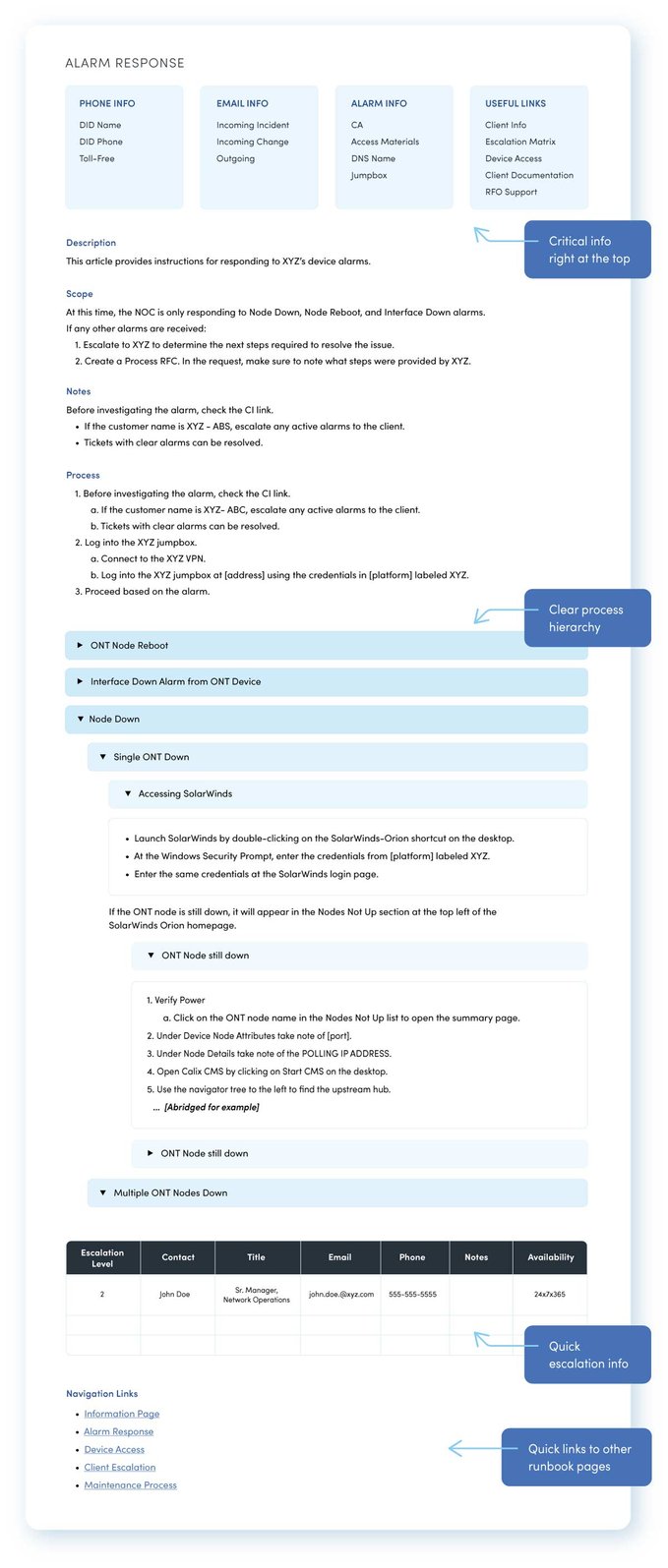
The fix is knowledge management, and it's more than a folder of documents! You need runbooks and alarm-to-action guides that tell an engineer exactly what to do when a specific alert fires, tied back to the CMDB so they know what's affected. You need standard operating procedures for the recurring work.
Many “mature” NOCs adopt a methodology like Knowledge-Centered Service to keep that knowledge current as part of the daily job rather than a cleanup project nobody ever gets to. Done well, this is what lets a new hire become useful in weeks instead of months, and what keeps your operation from depending on any single person.
Here’s the “anatomy” of a typical runbook we write to make this more concrete:
The People Problem, and the Math That Drives Most Teams to Strategically Outsource
This is usually where the internal-build conversation gets quiet, and often turns into a question about which NOC provider to partner with instead.
Covering a single seat around the clock is not one person. It's not even two or three. A year has 8,760 hours in it. Once you account for three shifts, weekends, holidays, PTO, sick time, and training, keeping one position continuously staffed takes roughly five people.
We recommend a 12-person minimum for a NOC that has to run 24x7, and that floor exists for a reason: it leaves enough capacity to cover time off, run training, define roles, help on project work, and let people keep a reasonable work/life balance. Staff below that line and you get burnout, turnover, and inconsistent incident handling. Overstaff by throwing bodies at the problem and you drain the budget without fixing anything structural.
And a headcount number is only the start.
-
You need a NOC manager focused on mentoring, process, and escalation.
-
You need a service transition role that brings new services and technologies into the NOC cleanly.
-
You need someone owning knowledge management.
-
You need a competency matrix and a learning management system so you can prove your team can actually do the work, plus a training calendar that gets updated whenever your services or technology change.
-
You need career paths, because "nowhere to go from here" is one of the top reasons good NOC staff leave.
You also need a test or UAT environment that mirrors production, so staff can practice recovery steps and validate runbooks before touching live systems. When teams get one, incident rates on new service deployments can drop by more than half. Most internal builds don't budget for it at all.
Measuring Whether Any of it Works
If you can't measure the NOC, you can't improve it, and you can't prove its value to the people funding it. That means tracking the metrics that reflect real performance: mean time to acknowledge, mean time to restore, first-level resolution, and staff utilization, among others.
Getting these numbers reliably usually means integrating your ITSM data with a reporting platform like Tableau or Power BI so leadership sees performance in real time instead of assembling spreadsheets by hand. That reporting is what surfaces the patterns you'd otherwise miss, like response times dragging on the overnight shift because it's understaffed. Without it, you're guessing.
Here’s a look at just a few of our many reports that our clients get who give their NOC support to us:
Service KPIs and ticket trends (like Time to Ticket)
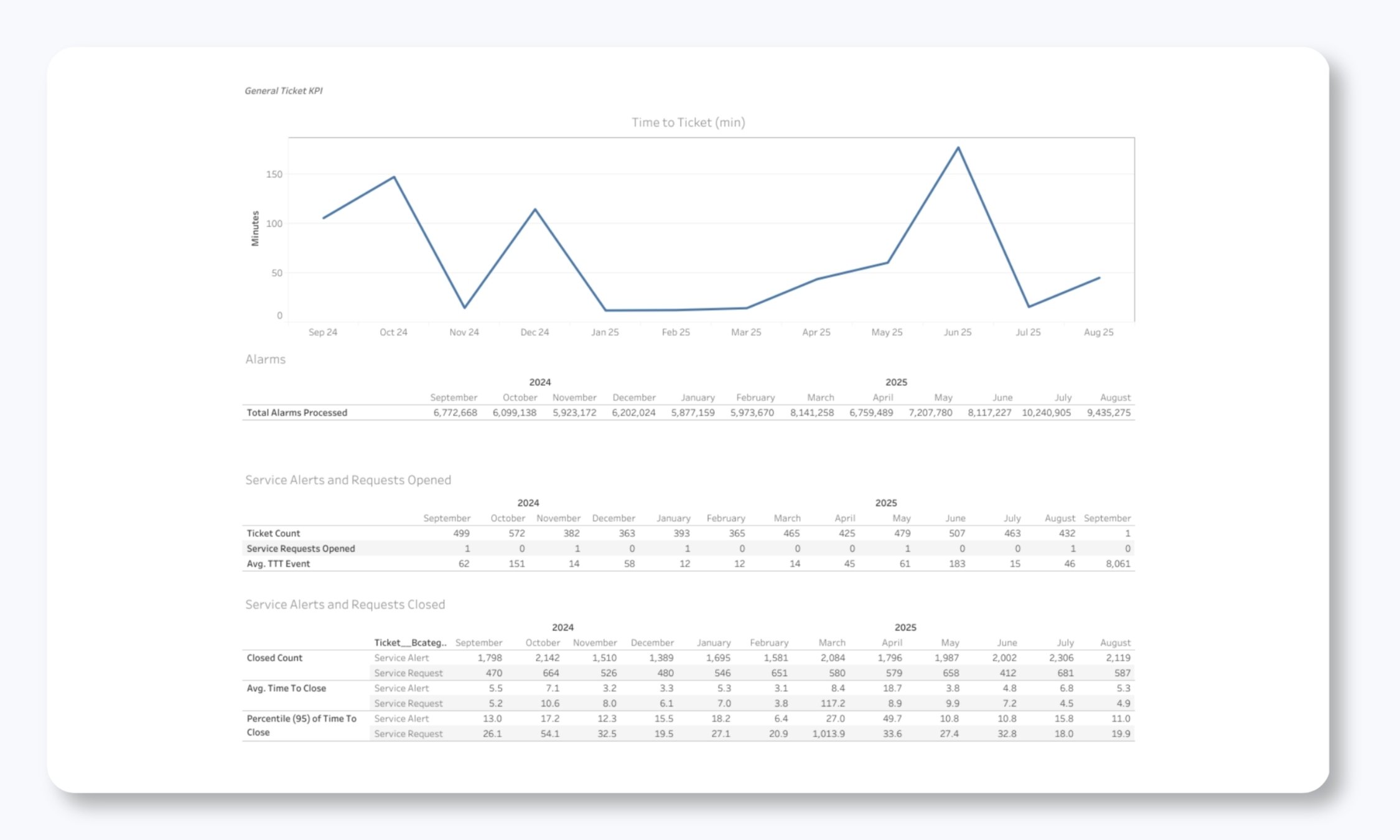
This is your command center view: the first place most clients look when they log into our service portal. This dashboard shows you:
- Total tickets opened and closed over the past few months
- Current open ticket count
- Breakdown by ticket type (Monitoring, Change, Problem, etc.)
- Tickets currently open by category
The power here is in the trending. You can immediately see whether ticket volume is increasing or decreasing, whether a backlog is building, and which types of issues are most common in your environment.
Monthly Ticket Report
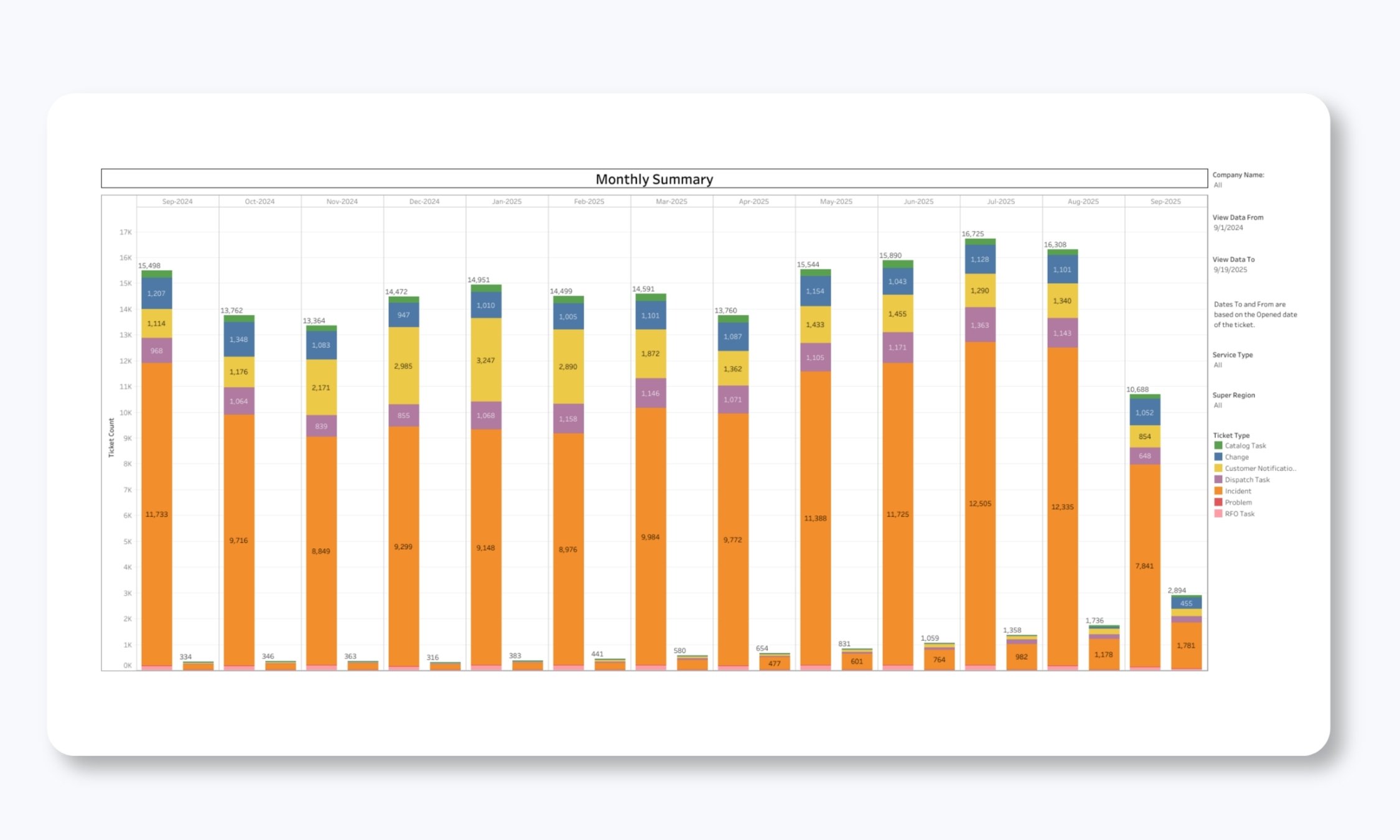
Our Monthly Ticket Report gives an even more detailed breakdown by ticket type and open/closed status. This report includes full drill-down capability, so you can click any data point to see the actual tickets that make up that number.
This transparency is critical! You're never wondering what's behind a statistic, which is one of the prime complaints we hear about prior NOC service providers: the numbers look good, but service feels poor.
Time to Close
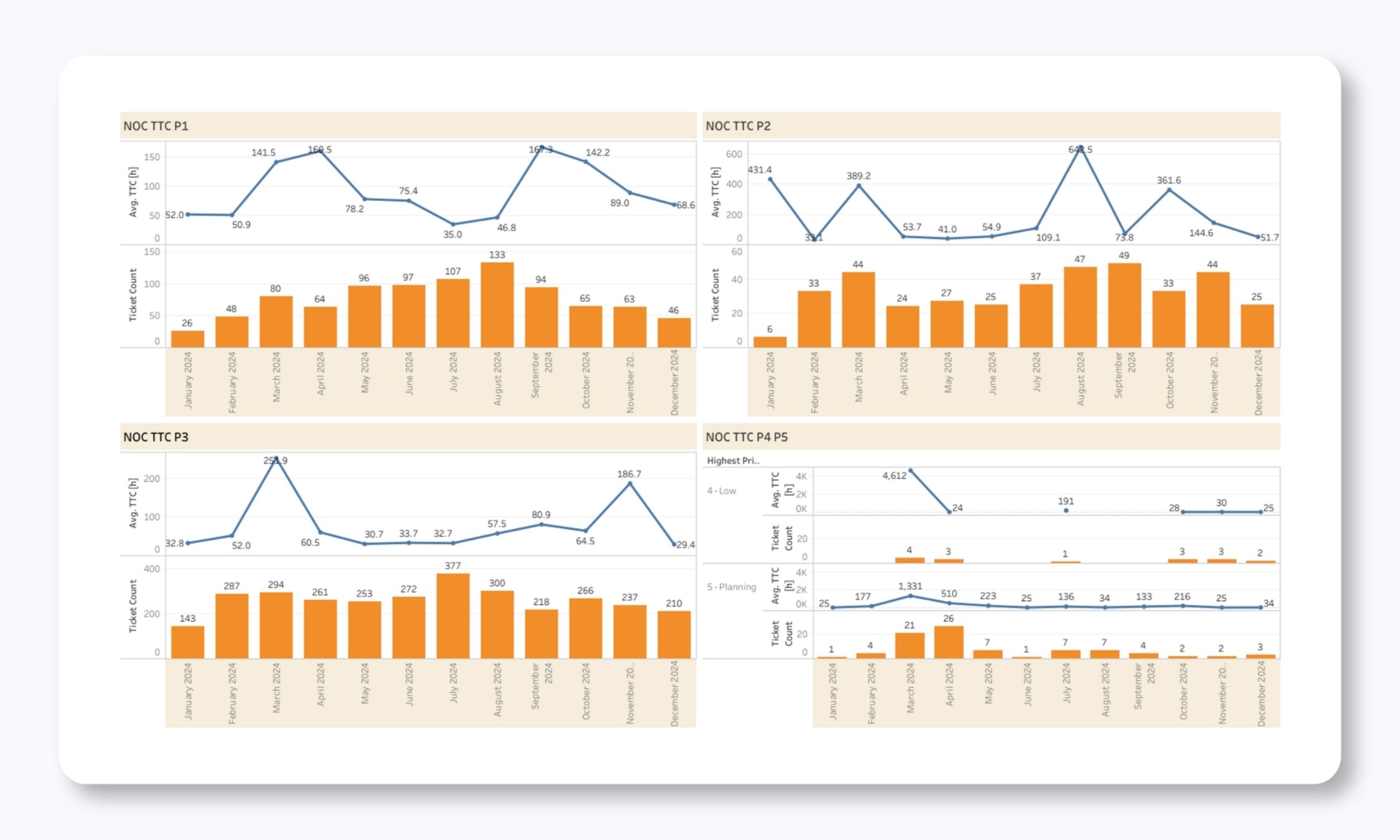
Time to Close tracks the complete lifecycle of a ticket from when it’s created through final resolution and closure. This metric encompasses all activities: NOC troubleshooting, vendor escalations, client actions, and administrative closure.
This is important because it shows the full picture of incident duration, not just the NOC's portion. If you're seeing long time-to-close metrics but fast time-to-action and time-to-restore, it might indicate that tickets are staying open for administrative reasons, which suggests an opportunity to streamline closure procedures.
The Part That Never Ends
Notice what the list above actually describes. It's not a stack you install and walk away from. Monitoring needs continuous tuning. The CMDB needs constant upkeep. Processes need enforcement and revision. Knowledge goes stale the moment your environment changes. People leave and have to be rehired, retrained, and rescheduled around the clock, forever.
That's the honest reveal of any NOC roadmap. The build is finite. The operation is not. For a lot of organizations, especially those where infrastructure support isn't the core business, standing all of this up internally means signing up to run a 24x7 operation that will compete for attention and budget with the work you actually set out to do.
A Few of the Questions We Actually Ask
If reading the roadmap is the slow way to find your gaps, here's the fast one. Below are questions we work through when INOC assesses a NOC, grouped roughly the way this roadmap is built. Don't try to answer all of them right now. Just notice which ones you can answer with real data, and which ones make you pause. The pauses are the map.
Talk to us if you want to run through a formal assessment.
On what the NOC is actually for:
- Do you have your required response and resolution times, per service and per severity, in writing and agreed to by the business?
- Which hours genuinely need coverage, and have you costed what continuous coverage really takes?
On monitoring and events:
- Can you state what percentage of the alerts reaching your team are worth acting on, versus noise?
- Is every actionable alert turned into a ticket you can track to resolution?
- When a dozen alerts fire from one underlying failure, does anything correlate them, or does a person do it by hand at 2 a.m.?
On your system of record:
- Is there one place where every incident, change, and problem gets recorded the same way, every time?
- When an incident hits, can your team immediately see which customers and services are affected?
- Does your configuration data match your real infrastructure today, or was it accurate a few months ago?
On process and knowledge:
- Do you have written, agreed criteria for how incidents get prioritized and escalated?
- Are your runbooks current and good enough to actually get someone to resolution?
- If your best troubleshooter is out for a week, does resolution time hold steady?
On people:
- Can you cover every shift and still absorb PTO, sick time, and training without the operation degrading?
- Is there a real path for a NOC engineer to grow, and a reason for your good people to stay?
On measurement:
- Can you show your first-level resolution rate and mean time to restore, and how both have moved over the past year?
- Do you have data connecting major incidents to their actual cost to the business?
Here's what usually happens when I sit down with a team and go through this list.: Most people can answer the first question in each group and stall on the second or third. That's not a knock! It's the normal state of a NOC that grew up reactively, one alert and one hire at a time, without anyone getting the room to step back and design it.
Those stall points are precisely what an assessment is for. We spend a week or two digging into these questions with your team, in interviews and in your actual data, and hand you back a prioritized report on what to fix first and what it's worth. You get answers to the questions above whether or not you go any further with us.
Two Ways Forward
If you've read this far and you still want to build internally, good! It can be the right call, particularly if NOC operations are central to what you sell. In that case, don't do it blind. Our NOC Operations Consulting practice exists for exactly this: we assess your current state, hand you a prioritized roadmap, and work alongside your team to put these pieces in place, from greenfield builds to optimizing a NOC you already run. You get our 20-plus years of doing this without learning every lesson the hard way.
If the operation side gave you pause, that's worth paying attention to. Plenty of organizations decide the smarter move is to plug into a NOC that already has all of this built and running, rather than construct it from scratch. That's the other thing we do: outsourced 24x7 NOC support, with the monitoring, processes, CMDB, knowledge base, staffing, and reporting already in place and proven, often at a fraction of the total cost of building it yourself.
Either way, the first step is the same conversation. Book a free consultation with one of our Solutions Engineers and we'll talk through your requirements, your service levels, and which path fits your business. You'll walk away with clear takeaways whether you end up working with us or not. If you'd rather do some reading first, download our white paper, The NOC Improvement Playbook, for the ten problems we see and solve most often in these engagements.
Standing up a NOC is absolutely doable. Just go in knowing what it actually is: not a tool you buy, but an operation you commit to running.

-images-0.jpg?height=2000&name=ino-WP-NOCPerformanceMetrics-01%20(1)-images-0.jpg)




-images-0.jpg?width=200&height=259&name=ino-WP-NOCPerformanceMetrics-01%20(1)-images-0.jpg)