
Over the past several years, we’ve been steadily evolving the INOC platform (currently in its third major iteration) from a tightly integrated delivery engine for our own NOC services into a more flexible system that supports direct client participation, self-service, and even full platform-as-a-service deployments.
That evolution has now entered a new phase as we move closer to Platform 4.0.
Working closely with our colleagues at Xerox IT Solutions, and with a new proof-of-concept underway with a major AI leader, we’re beginning to apply GenAI and agentic AI directly inside the Tier 1 workflow.
The goal here is simple and one that NOCs have been working toward for decades: reduce the repetitive work human engineers handle today while improving clarity, consistency, and speed for customers and end users.
The swim-lane diagram below illustrates the high-level model we’re building toward. As more teams ask us what an “autonomous Tier 1” will look like, this is our answer.
Xerox INOC Platform 4.0: The Autonomous NOC of Tomorrow
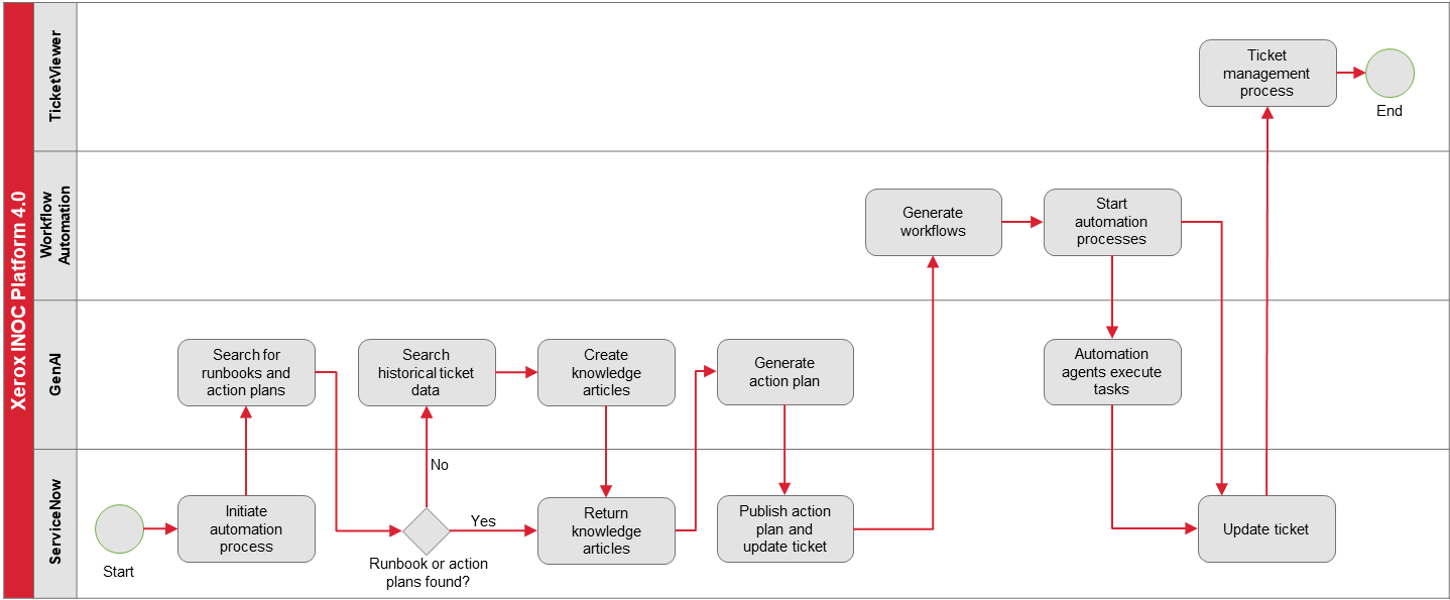
Rather than marketing jargon or blue-sky theory, this is grounded in what we have already built, what’s in production today, and what we are actively testing.
Let me quickly run through its mechanics.
How the Autonomous NOC Workflow Works
Let’s break this down step-by-step in simple terms.
1. It starts with ServiceNow initiating standard automation
Every incident begins like it always has: our ServiceNow architecture kicks off the workflow, and the platform checks whether a runbook or action plan already exists. That part of the process is already in place (and “operationally mature”) because we’ve spent years building repeatable procedures around infrastructure monitoring, notifications, carrier escalations, and incident lifecycle management.
What is new is how runbooks stay accurate. Through our self-service portal, clients will review and approve their own runbooks and knowledge articles, closing the loop on one of the biggest historical failure points: outdated instructions.
Infrastructures almost always change faster than the runbooks used to manage them. Now we can finally stop playing catch-up. If a runbook already exists, the workflow can return it immediately without human intervention. This, on its own, means a massive improvement in operational efficiency.
2. If the platform can’t find a runbook, it now looks across historical ticket data
This is where GenAI begins to play a significant role.
Our NOC platform can ingest long, complicated ticket histories (often hundreds of lines of notes) and generate a concise, actionable summary for the next engineer. This is already in our live production environment today. It helps cut down the time humans spend scrolling and interpreting pages of updates just to determine the next step.
In the near future, the system will also generate candidate resolution notes at the end of an incident. Engineers still validate them, but it will speed up the write-up process and make communication even clearer for client teams.
3. When no runbook exists, the platform generates a first draft of a knowledge article
This capability is currently in testing. If an incident is a good example of a repeatable scenario, our GenAI engine will be able to produce a draft knowledge article or runbook based on the steps taken. The human engineer simply reviews and adjusts the draft instead of writing it from scratch.
This is one of the earliest building blocks of what can genuinely be called an autonomous Tier 1: the ability to continuously enrich the knowledge base through real operational work.
4. The platform then generates an action plan and (in some cases) publishes it back into the ticket
Once the system has enough context, it will be able to actually suggest what to do next. In today’s environment, this shows up as:
- Candidate resolution notes the engineer approves or edits.
- Condensed summaries that inform the next troubleshooting step.
- Recommended actions based on patterns in historical data.
Again, to be crystal clear, this is not free-running automation. A human is still in the loop! But the system is already reducing cognitive load and increasing consistency. We expect efficiency to continue and accelerate over time.
5. Automation workflows can be generated and triggered from this context
We’ve launched a proof-of-concept with a major AI partner focused specifically on building an autonomous Tier 1 layer. This aligns with the portion of the chart where the action plan feeds into workflow generation and the platform begins executing certain tasks automatically.
For example:
- Parsing inbound carrier emails.
- Creating change tickets.
- Extracting circuit IDs and attaching CIs.
- Routing events based on maintenance windows.
- Performing tone-based prioritization when communications indicate frustration or urgency.
To be clear again, these are early agentic AI use cases: narrow, high-value, low-risk tasks that remove manual effort while preserving human oversight. We’re not handing over more than what ought to be handed over.
6. Automation agents then execute tasks where appropriate
Today, this includes:
- Suppressing alarms during scheduled maintenance.
- Triggering escalation workflows.
- Enforcing on-call notification rules.
- Enriching incidents with structured data.
In the proof-of-concept currently in development, we’re working toward enabling the system to perform more of the “Tier-1-style” work (triaging, summarizing, classifying, and creating recommended actions) without requiring a human to touch the ticket until the decision truly requires human judgment.
This is the direction, not a promise that the system will self-correct or resolve arbitrary issues on its own.
7. A human reviewer remains part of the workflow
I cannot emphasize enough that we are intentionally building this with guardrails everywhere. Because we handle sensitive, client-specific data, we are not simply pushing everything into public LLMs.
We’re using ServiceNow’s GenAI capabilities (built to maintain tenant-level data isolation) and layering agentic automation on top of that.
Every AI-generated action plan, knowledge article, and resolution note is still reviewed by a human before it becomes part of the ticket or the knowledge base. That’s not a limitation. We see it as a key part of responsible deployment.
What This Means for Our Clients
A few important things implications emerge right away for those we serve through NOC and broader ITOps support:
Where We’re Headed
Autonomy in the NOC (to us) is all about eliminating the work that doesn’t require judgment so people can focus on the work that does. This is our roadmap: a system that gathers context, proposes action, enriches knowledge, and executes well-understood tasks automatically, while humans stay firmly in the loop.
We’re also not interested in chasing hype. We’re applying GenAI where it’s genuinely useful for the NOC and valuable for clients. And as our current work—alongside our continued focus on responsible architecture—progresses, Platform 4.0 will continue to evolve into a more intelligent, more autonomous operational layer.
That’s the future of our NOC, and this chart is the blueprint guiding us there.
If you’re interested in seeing how these capabilities translate into real operational gains or want to explore how autonomous Tier 1 support could fit into your environment, reach out to us. We’re happy to walk you through the platform, share what we’ve learned so far, and help you determine where AI-driven NOC automation can make the biggest impact.
Free white paper Top 11 Challenges to Running a Successful NOC — and How to Solve Them
Download our free white paper and learn how to overcome the top challenges in running a successful NOC.


-images-0.jpg?height=2000&name=ino-WP-NOCPerformanceMetrics-01%20(1)-images-0.jpg)





-images-0.jpg?width=200&height=259&name=ino-WP-NOCPerformanceMetrics-01%20(1)-images-0.jpg)